
By the imhoff.us Archive
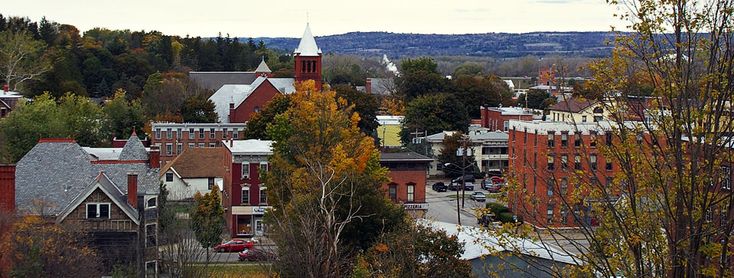
There is a particular kind of American place that does not announce itself. It has no famous skyline, no monument that draws tourists, no single event so dramatic that it seizes the national imagination. What it has instead is continuity, the kind that accumulates in cemetery lots and church registers and the columns of a weekly newspaper, layer upon layer, generation upon generation, until the place itself becomes a kind of record. Clinton, New York, in Oneida County, is that kind of place.
The Pryor family of the imhoff.us archive found their way to Clinton in December 1853, and the last of them was buried in its churchyard in 2002. Between those two dates, 149 years of American life passed through this village: wars, epidemics, depressions, the slow death of industries, the quieter survival of faith and community. The Clinton Courier, the village’s weekly newspaper, was there for most of it, recording the names and the dates, the comings and the goings, the men who went to war and the families who waited. That is what small-town newspapers do, and it is why they matter.
This is the story of Clinton, and of the family that made it home.
The Village That Veterans Built
Clinton did not begin as an immigrant town. It began as a soldier’s town.
In March 1787, eight pioneers from Plymouth, Connecticut, led by Captain Moses Foote, a veteran of the Revolutionary War, pushed into the southern reaches of what would become Oneida County and staked their claim in the Oriskany Valley. The Founders’ Monument in the village green lists their names: Moses Foote, Barnabas Pond, Bronson Foote, Luther Foote, Ira Foote, James Bronson, Levi Sherman, and Ludim Blodgett. They had fought for a republic, and now they were building one from scratch, one farm at a time. The Seneca people had called the area Ka-dah-wis-dag, meaning “white field.” The Connecticut men called it Clinton, after New York’s first governor, George Clinton, fourth Vice President of the United States.
What they found was good soil, plentiful timber, and the Oriskany Creek running through it. What they built, within a single generation, was remarkable. By 1835, the town had two tanneries, a distillery, a trip hammer, two woolen mills, a cotton factory, six carding machines, two fulling mills, seven saw mills, and five grist mills, with a population of approximately 700 people. A community had taken root.
The village acquired something else in 1793 that would define its character for the next two centuries. Presbyterian minister Rev. Samuel Kirkland founded Hamilton-Oneida Academy as a seminary to serve as part of his missionary work with the Oneida tribe. The Academy became Hamilton College in 1812, making it the third oldest college in New York, after Columbia and Union. The presence of a college gave Clinton its reputation. Clinton was once known as the “village of schools” because many private schools operated there in the 1800s, and people in 1878 said that Clinton was a great place for education, helping to improve the community’s morals. A survey eventually identified more than 60 schools that had operated in Clinton between 1790 and 1915, from the celebrated Clinton Grammar School, where Grover Cleveland and Elihu Root received part of their educations, to small one-room schoolhouses scattered through the township’s farms. It was called, simply, “Schooltown.”
But education was only part of the village’s economy. Beneath the farms and the college green, Clinton sat atop something the original settlers had not anticipated. Iron ore was first discovered on the farm of James D. Stebbins on the easterly side of town in 1797, and the mineral deposits ran in a line through Oneida County starting in Verona and Westmoreland, where the line cut south through Kirkland and southeast to the Village of Clinton. That discovery would shape the lives of every working family in the township for a hundred and sixty years. From 1852 to 1964, the ore was mined in the town and used at the Franklin Iron Works and later at the Clinton Metallic Paint Co. The iron mines, and the furnaces that processed their ore, drew a different kind of resident to Clinton than the Connecticut farmers or the Hamilton College scholars, drawing men who worked with their hands, men willing to go underground or into the furnace heat for a wage, and among them, wave after wave of Irish immigrants.
The Newspaper That Watched It All
Before there was a Pryor in Clinton, there was a press.
The newspaper that would eventually become the Clinton Courier began as the Clinton Signal in July 1846, the work of one L.W. Payne. In 1848, certain members of the senior class of Hamilton College offered their aid to the paper and it was called the Radiator. This lasted only a year and the name was changed back to the Clinton Signal. Mr. Payne was joined by Ira D. Brown and the two established the Oneida Chief. In 1856 it was sold to Francis E. Merritt, who a year later sold it to Galen H. Osbourne, who changed the name to the Chief and Courier. In August of 1859 Mr. Osbourne sold the paper to M.D. Raymond, who continued to publish it until May 1, 1875, when he finally sold it to J.B. Sykes. Mr. Sykes changed the name to the Clinton Courier.
Under that name, the paper would run for nearly a century, until 1956, faithfully recording the life of the village through the Civil War, the Gilded Age, two World Wars, and the Depression. Its columns carried the births and marriages, the farm reports and college news, the lists of men gone to war and, in harder weeks, the lists of those who would not be coming back. When James Daniel Pryor died in October 1921, the Courier was there to note his passing, recording him as “one of the pioneer residents and one who enjoyed the esteem and respect of all who knew him.” That sentence is the kind of obituary a community writes for a man it actually knew. He had earned it across 68 years of living in its fields and pews and roads.
The Coming of the Irish: December 1853
James Daniel Pryor was born in Ireland on March 16, 1830, the son of John Pryor and Anne Kiernan. He grew up in a country being systematically destroyed.
The potato blight arrived in 1845. By the time it had run its course, more than one million Irish had died of starvation and disease, and another million had fled. The ships that carried the Irish to America in the late 1840s and early 1850s were crowded, dangerous, and often deadly. Those who survived the crossing arrived in New York Harbor with little more than the clothes they had worn for the voyage. The songs they carried with them, the ballads of exile and longing that would become the backbone of Irish American folk tradition, were among the only things that weighed nothing.
James Daniel Pryor survived all of it. He married Margaret Robinson, born in Ireland in 1833, on January 8, 1853, at Saint Mary’s Church in Clinton, New York, before they had even sailed. It was an act of faith, or perhaps of practical determination: they would begin American life already bound to each other, already belonging to the parish that would anchor their family for the next 150 years. On December 19, 1853, the couple stepped off the ship James Fitz in New York Harbor and made their way to Oneida County.
The America they arrived in was a country beginning to fracture. The Kansas-Nebraska Act was a year away. The Dred Scott decision was four years in the future. Uncle Tom’s Cabin had been published the previous year and was selling in numbers no American novel had ever reached. The country was arguing about slavery in a way that was moving beyond argument toward something worse. James and Margaret Pryor had left one catastrophe and were arriving at the edge of another, though they could not have known it.
What they found in Clinton was a church, a community, and work.
The iron mines, the building of the Chenango Canal, and later the knitting mills, brought many Irish settlers to the Clinton area. The first authentic account of the settlement of Catholics in Clinton is of a James McGuire and his family from Ireland, at whose home Mass was first celebrated. By the time James and Margaret arrived, the Irish Catholic community in Clinton was already taking shape around Saint Mary’s Church, and on April 30, 1851, a building lot for a church had been purchased from Judge Williams for $125 on the same site on Marvin Street upon which the present church stands. The Pryors walked into a community that was still building its own institutions, still planting its own roots. They fit exactly.
James Daniel established himself as a farmer, working the Oneida County soil that was not so different, in its demands, from the Irish land his family had worked for generations. They settled near Kirkland Iron Works, in the Clinton area, embedded in the tight Irish Catholic world of the parish. By the time the Clinton Courier was being established under that name in 1875, James Daniel Pryor was already a recognized member of the community, a man whose face was known on the roads into the village and in the pews of St. Mary’s.
The Civil War Years: Clinton Sends Its Men
The Clinton Courier and its predecessors would have carried a particular kind of news through the years 1861 to 1865.
Oneida County raised five infantry regiments of volunteers during the Civil War: the 14th New York Infantry, the 26th New York Infantry, the 97th New York Infantry, the 117th New York Infantry, and the 146th New York Infantry. The ten companies of the Fifth Oneida were principally recruited from local towns, with Company G drawn from Clinton, Kirkland, Bridgewater, and Plainfield.
James Daniel Pryor had been in America for less than a decade when the war began. He was 31 years old, a farmer with a young family, a man who had already survived the Famine and the crossing and the hard work of building a life from nothing. Whether he or any of the extended Pryor and Robinson network around him served in uniform, the records do not definitively confirm. But the war was impossible to be unaware of. The men of Company G, his neighbors and fellow parishioners, marched out of Clinton and Kirkland and went south. The 146th New York, the Fifth Oneida, lost staggering numbers. The Fifth Oneida left Rome for Washington, DC in October 1862 with approximately 850 men. When the unit was mustered out of service on July 16, 1865, 264 were accounted for. When the regiment paraded through Utica in late July 1865, only 120 were on hand.
The Courier would have published their names. The Clinton community would have known every one of them. James Daniel Pryor, Irish-born farmer of the Kirkland area, would have read those columns, or heard them read, in the years when the village held its breath and waited to learn who was coming home.
The Old Burying Ground in Clinton holds the graves of 48 Revolutionary War veterans and many other local historical figures. After the Civil War, the cemetery filled further. Clinton knew the cost of war in the way that small towns know it: not as a statistic but as a name, a face, a pew left empty.
Margaret E. Pryor: A Life That Spanned the Centuries
Among the children James Daniel and Margaret Robinson Pryor raised in Westmoreland and Clinton was a daughter born November 4, 1863, in Westmoreland, Oneida County. They named her Margaret, after her mother.
She was born the year Lincoln signed the Emancipation Proclamation. She was born as the Fifth Oneida was fighting its way through the Virginia campaigns that would end the war two years later. She was, in every sense, a child of the Civil War era, born into a village and a family that were living through the defining catastrophe of nineteenth century America from the remove of an Oneida County farm.
Margaret E. Pryor lived for 94 years. She died on March 13, 1958, at the Summit Nursing Home in Utica, New York, the same year the Soviet Union launched Sputnik and the space age began in earnest, the same year Elvis Presley was drafted into the United States Army and Chuck Berry recorded “Johnny B. Goode.” She had been born in Lincoln’s America and she died in Eisenhower’s.
In between, she had witnessed the entire arc of the country’s industrial transformation, the closing of the frontier, the Gilded Age, the progressive era, two World Wars and the Korean War, the Great Depression, the rise of the automobile, the invention of radio and television and the long slow modernization of the Oneida County world she had been born into. She appears in the records as a woman of Westmoreland and Clinton, unmarried, whose life was embedded in the same parish and farming community as her parents and siblings. She was, in the way of many women of her era and class, invisible to history but essential to the family around her, a constant presence in the background of the records her brother Daniel Henry and nephew James Houston left behind.
When she died at 94, the Courier, or its successor paper, almost certainly noted her passing. She was, by then, one of the last living threads back to the world James Daniel and Margaret Robinson Pryor had built from scratch in 1853. Her death closed a chapter of the Pryor story that had opened when her parents stepped off the James Fitz into New York Harbor.
Daniel Henry Pryor: The Generation That Stayed
Born April 20, 1872 in Westmoreland, Oneida County, Daniel Henry Pryor was the second generation of the American Pryor line. He never left.
He came of age during the Gilded Age, a period that the Clinton Courier would have covered with the mix of local boosterism and farm news and social columns that defined small-town weekly journalism of the era. He was growing up as the iron mines around Kirkland were in full operation, as the knitting mills in Clark Mills were humming, as the Utica, Clinton, and Binghamton Railroad, which had arrived in Clinton in 1866, was still carrying passengers and freight through the township.
He would have been a young man when the Courier reported on the Spanish-American War of 1898, and middle-aged when the paper’s columns would have been heavy with the names of the young men of Clinton and Kirkland going to the Western Front in 1917 and 1918. He was 46 years old when the Armistice was signed on November 11, 1918, and the church bells rang across Oneida County. “Over There,” the George M. Cohan song that had sent a generation to war, had been the marching tune of the year. Now it was over, and Daniel Henry was still in Kirkland.
He lived until September 15, 1953, dying at age 81 at Kirkland Iron Works, the iron industry that had drawn his parents’ generation of Irish immigrants still operating, barely, into the middle of the twentieth century. He died the year Stalin died, the year the Korean War ended, the year From Here to Eternity was in movie theaters. A quiet, rooted life, spent in the county where his parents had arrived as strangers seventy years before.
The Great War and Its Shadow
The Clinton Courier of 1917 and 1918 would have been a paper of a particular kind of grief.
Oneida County sent its young men to France as it had sent them to the Wilderness and Gettysburg half a century before. The names in the paper were now names like Pryor and Welch and McCabe, Irish names mingled with the Italian and Polish names of the newer immigrant communities that had been filling Utica’s neighborhoods since the 1880s. Clinton was still, in 1917, a predominantly Anglo-Protestant village, but the Irish Catholic community of St. Mary’s was thoroughly woven into its fabric by then, and the parish rolls of the war years carried their share of names from among the families that had arrived from the Famine ships in the 1850s.
The 1920s came next, the decade of contradictions. Prohibition, the rise of the Klan in upstate New York, the jazz age, the Model T, and the radio. James Houston Pryor, Daniel Henry’s son, was a teenager in the 1920s, and the Clinton Courier of those years would have covered the same mix of college news, farm reports, and local politics it always had, with perhaps a new note of the century’s novelty, advertisements for automobile dealers and radio dealers and the other equipment of modernity beginning to appear alongside the older notices for harness shops and seed merchants.
James Houston was born on April 5, 1907, in Clinton, the same year Oklahoma became the 46th state. He grew up hearing Scott Joplin’s ragtime on phonograph cylinders and came of age as jazz was taking over American popular music. When he married Lorretta Mary Welch on October 28, 1936, at St. Mary’s Church, the witnesses were Joan McCabe and Howard Clute, names that appear in the Clinton parish records as solidly as the Pryors themselves. The Welch family had been woven into the same Irish Catholic community for as long as anyone could remember. Benny Goodman’s Swing was the music of that autumn, and the radio carried it into the farmhouse kitchens of Oneida County as readily as it carried the news of Hitler’s expanding Reich from across the Atlantic.
World War II: The Family Goes to War Again
Joseph Daniel Pryor, son of James Houston and Lorretta and brother of Anne Marie, served in the United States Navy in World War II.
He was one of millions. The Clinton Courier of 1942, 1943, and 1944 would have carried the same columns of names that its predecessor had carried in 1862, 1863, and 1864, the men of Kirkland and Clinton going to the Pacific and to North Africa and to Normandy, the Gold Star notices, the casualty lists, the brief formal notifications that arrived in the mailboxes of families who had been watching the mail every day with a dread they did not speak aloud. “Don’t Sit Under the Apple Tree” and “White Christmas” were the songs on the radio while the boys were gone. Bing Crosby’s version of “White Christmas” became the bestselling single in American history, selling millions of copies to a country that wanted nothing more than for its sons and brothers to come home.
Joseph Daniel Pryor came home. He came home, married, raised a family, and spent the rest of his long life doing something that in retrospect seems both quiet and essential: he remembered. He became the family historian, the keeper of records, the man who knew which census year listed which cousin, which church register held which baptism, which photograph belonged to which face. It is largely through his work, the documents gathered, the family stories verified, the photographs identified and preserved, that the Pryor line is as richly documented in the imhoff.us archive as it is today. He served his country in uniform and then served his family in memory. Both mattered.
Lorretta Mary Welch Pryor: Gone Too Soon
Lorretta Mary Welch Pryor died on April 3, 1964, at St. Luke’s Hospital in Utica. She was 57 years old.
She had been born on January 19, 1907 in Clinton, a daughter of the same Irish Catholic parish community that had produced the Pryors, the McCabes, the Bradys, and all the other families whose names recur through St. Mary’s baptismal and marriage records across a century. She married James Houston in 1936, raised her children through the war years, and died far too young, eighteen weeks after President Kennedy’s assassination, while the country was still learning to absorb what had happened in Dallas.
The Beatles had just landed in America. “I Want to Hold Your Hand” was number one. A cultural revolution was beginning that Lorretta did not live to see. She was buried, as the Pryors had always been buried, in the Clinton churchyard, returning to the same earth where James Daniel and Margaret Robinson had been laid to rest forty-three years before her.
James Houston lived on without her for thirty-one more years, dying on January 28, 1995 at his home on Floyd Avenue in Rome, New York, the year the internet became publicly accessible and Hootie and the Blowfish were selling millions of records. He had moved from ragtime to rock to something entirely beyond music in 87 years of American life.
Saint Mary’s Church: The Constant
Through all of it, the church on Marvin Street remained.
The cornerstone for the present church building at St. Mary’s Clinton was laid on June 12, 1910. The stone itself is dated 1909, the year the old church was demolished and the work started on the present building. The church was completed near the end of 1912 for a cost of $91,101.74, and dedicated on January 5, 1913 by Bishop Grimes of Syracuse.
It was in this building, or in its predecessor on the same site, that every major event of the Pryor family’s American story was marked. James Daniel and Margaret Robinson Pryor were married there in January 1853. Daniel Henry was baptized there. James Houston and Lorretta Welch were married there in October 1936. Anne Marie Pryor was christened there on March 27, 1938, with Clarence Brady and Agnes Welch as godparents. Anne Marie married Richard Joseph Imhoff there on November 28, 1959, on the Saturday after Thanksgiving, to Paul Anka on the radio and the Cold War outside the door.
When Anne Marie died in September 2002 and was buried in St. Mary’s Cemetery on September 17 of that year, she was returned to the same ground where James Daniel had been buried in 1921, where Lorretta was buried in 1964, where generation upon generation of the Clinton Irish Catholic community had been laid to rest since the 1850s. It is a continuity of 150 years, maintained not by any formal institution but by the simple, repeated choice of one family to return, in the end, to the place where they had begun.
The Old Burying Ground and the Long Accounting
Clinton keeps its dead with particular care.
The Old Burying Ground in Clinton holds the graves of 48 Revolutionary War veterans, the men who came from Plymouth, Connecticut in 1787 and built the village from nothing. Alongside them lie the generations that followed, the farmers and mill workers and teachers and iron miners, the men who went to the Civil War and came back and the men who went and did not, the women whose names appear in the baptismal registers and the obituary columns and the scholarship funds established in their memory.
The Pryors are among them. Section 2, Lot 19 of St. Mary’s Cemetery: James Daniel Pryor, 1830 to 1921, the man who stepped off the James Fitz in 1853 and spent 68 years becoming what the Courier called “one of the pioneer residents.” Alongside him and near him, across the generations, the family he built from nothing: Margaret Robinson, Daniel Henry, Margaret E. with her 94 extraordinary years, Lorretta Welch, Anne Marie, the whole accumulated weight of a family’s American life measured out in stone and dates and the simple fact of proximity, even in the ground.
What the Courier Recorded
The Clinton Courier ran from 1859 to 1956. Its successor papers, The Courier, carried the same tradition forward. Across those decades, it recorded Clinton in all its dimensions: the town meetings and the college news, the harvest reports and the election results, the birth notices and the death notices, the names of the young men going to war and the notices of their safe return.
It recorded James Daniel Pryor’s death in October 1921. It recorded the names of the Clinton men who went to the Western Front. It recorded the local impact of the Depression, the closing of the iron mines, the shifting economics of a village that had always been more educational than industrial. It recorded the arrival of the railroad in 1866 and its departure, the passenger service discontinued in the mid-1930s, the freight trains running until 1957. It recorded the life of a place across a century of enormous change, and in doing so it preserved, column by column and week by week, the record of families like the Pryors who would otherwise have left no trace beyond a name in a church ledger and a stone in a field.
That is what the Courier was for. That is what a local newspaper, at its best, has always been for.
A Village That Holds Its History
Clinton today is a village of about 1,700 people. Hamilton College is still on the hill. The village green is still there, the Founders’ Monument still listing its eight Connecticut veterans. The Old Burying Ground still holds its 48 Revolutionary soldiers. St. Mary’s Church still stands on Marvin Street, still celebrating Mass, still recording in its registers the baptisms and marriages and burials of families whose names have been in those books for more than a century and a half.
Clinton is also the original home of the nationally known Bristol-Myers Company, which got its start in the second floor rooms of a West Park Row building in 1887. The iron mines are gone, closed in 1963 after 180 years of operation. The knitting mills are gone. The railroad is gone. But the college is there, and the church is there, and the cemetery is there, and the archive of the Courier and its successors sits in the libraries of Oneida County, waiting for anyone who wants to know who lived here, and what they did, and when they were born and married and died.
The Pryors are in that archive. They are in the church registers of St. Mary’s and in the lot records of the cemetery and in the memory of a family that has been, for 170 years, unwilling to let their story be swallowed by time. The imhoff.us genealogical archive, built from the records gathered by Joseph Daniel Pryor and preserved across generations, is the latest form of that refusal.
James Daniel Pryor arrived in Clinton in December 1853. The Clinton Courier was still three years from taking its final name. The Irish Catholic community he was joining was still building its first church. The Civil War was eight years away. He was 23 years old, a farmer’s son from a country that had nearly destroyed itself, standing on the soil of Oneida County for the first time, and beginning.
What he began is still here.
This article was compiled from records in the imhoff.us genealogical database, the Clinton Historical Society archives, the Library of Congress Chronicling America collection, and historical research into the Town of Kirkland and Oneida County. The Clinton Courier archive (1859,1956) is held in the New York State Library and at the Utica Public Library on microfilm. If you have photographs, documents, or personal memories related to the Pryor family of Clinton, or to any of the families documented in this archive, contributions are welcomed through the Contact page.