Corporal Bartholomew Quinn (1876–1956) – Soldier of the Philippine Pacification Campaign


Origins in Oneida County

Bartholomew Quinn was born on July 21, 1876, at Kirkland Iron Works in the town of Kirkland, Oneida County, New York — an industrial hamlet built around the iron-forging trade that had drawn working families to the Oriskany Creek valley since before the Civil War. He was the son of Thomas Foran Quinn (born c. 1845, died 1919, Clinton, Oneida County) and Alice Houston Quinn (born August 19, 1853, died 1933). His father’s roots were Irish, his mother’s family established in the same corner of central New York where the Imhoff and allied families had put down roots a generation earlier.

He was twenty-three years old when the United States called for volunteers to extend American authority across the Pacific, and he answered.


Enlistment and Deployment

On August 3, 1899, Bartholomew Quinn enlisted in the 26th Regiment, United States Volunteers — one of several regiments raised in the aftermath of the Spanish-American War specifically for service in the newly acquired Philippine Islands. The regiment trained at Plattsburg, New York, then paraded through Boston, Massachusetts before embarkation. The men were initially issued pith helmets, which proved so impractical they were quickly replaced by campaign hats. Their standard arm was the Krag-Jørgensen repeating rifle, nearly five feet long and the best infantry weapon the Army had seen to that point. Each company fielded roughly 106 men.

The regiment sailed from San Francisco aboard a transport believed to be the U.S. Grant, under the command of Lt. Colonel Edwin M. Walker, whose wife was the only woman aboard. Twenty-eight days later, they arrived at Manila Bay. What awaited them was not the tidy aftermath of a war already won.


The Philippine Campaign

The Philippine-American War — officially termed the “Philippine Pacification Campaign” by the War Department — was a grinding guerrilla conflict fought in jungle, river bottom, and rice paddy against Filipino insurgent forces who knew the terrain and were fighting for their independence. Bart was assigned to Company C, operating in Iloilo Province on the island of Panay, and he kept a meticulous diary from October 30, 1899 through July 1900. That document, preserved in this family archive as QUIB1876_19000101_DOC_JRN_01, is among the few surviving enlisted-man’s accounts of the campaign in this theater.

His first entry, dated October 30, 1899, is characteristically understated: “Vaccinated. Very sore arm.”

Within two weeks, he was in combat.


Under Fire: November 1899

On November 10, 1899, Company C marched to San Isidore, where an engagement with Filipino insurgents left Corporal Corbett wounded and three Filipino fighters killed, five more wounded. The 18th Infantry took part alongside them. Bart passed through the town of Mandoray and noted, almost as an aside, that he had been acting corporal in the battalion drills.

The most significant early action came on November 21, 1899 — the Battle of Jaro. Company C was roused at 1:30 in the morning, forded a river in darkness, circled to the enemy’s rear, and attacked. The fighting lasted two hours in brutal heat on waterlogged ground. The Americans captured prisoners, supplies, and four smoothbore guns. One prisoner stabbed a corporal and was shot on the spot. All buildings in the vicinity were burned. The 6th Artillery, meeting some 800 retreating insurgents, inflicted heavy casualties. Gunboats shelled the enemy entrenchments from the river. That same afternoon, Bart went out again with 24 others to scout, finding many dead and recovering a Mauser rifle, bayonet, bolo knife, and two boxes of cartridges. He watched columns of prisoners — men, women, and children — being marched through town.

Four days later, on November 25, the company undertook a forced march of more than twenty miles, setting out at 2:00 in the morning. When they reached Filipino fortifications at an uncrossable river, they turned back. Along the roadside lay eight dead Filipino men — arms bound, hands and feet severed, throats cut. “The stench was terrible,” Bart recorded. The mules gave out before they reached home, and soldiers were put in their harnesses to haul the wagons. He reached quarters near midnight, describing himself as “most dead.”


Life in Garrison

Between engagements, the diary is an irreplaceable portrait of American soldier life in the occupied Philippines. Bart attended Catholic mass in churches he found magnificent — and noted bitterly that Tennessee troops had already looted the finest of them. He watched local funerals conducted to the music of brass bands. He attended a cockfight and found it entertaining. He complained about the food, the mosquitoes (“as big as birds”), the punishing heat, and the tuba — a potent fermented palm wine that seemed constantly to be incapacitating his fellow soldiers, including old Gillick, who raised enough hell on the substance to earn an $15.60 fine and eight days of hard labor.

His closest friend in the ranks was Joe Oldridge, a soldier from Massachusetts. When Oldridge was sent to the hospital at Iloilo in early December, Bart wrote simply: “Very lonesome without him as he is a fine fellow.” They maintained a correspondence for years after the war.

Christmas Day 1899 fell somewhere between absurd and poignant. Breakfast was sowbelly, hardtack, tomato sauce, potatoes, and coffee with milk. The weather was as hot as July in New York. Bart called it a swell dinner.

The letters that meant most to him were the ones from home. When he returned from a brutal ten-day mountain expedition in early January 1900, ragged and all but barefoot, and found mail waiting, he wrote: “Never had anything do me as much good as them — letters from home — Father, Mother & Sister.”

Thomas and Alice Quinn, still living in Oneida County, had a son overseas and did not always know whether he was alive.


Lost in the Mountains

The New Year’s expedition stands as the diary’s most vivid sustained passage. On January 1, 1900, Company C set out into the mountains to hunt the Ladrones — brigand-insurgent forces operating in the highlands. Bart described it as the hardest thing he had ever done. The men marched all day and camped at night, cooking sowbelly and boiling coffee, climbing steep ridges under a merciless sun. After ten days, his shoes had completely disintegrated. They located the Ladrones’ headquarters and had a skirmish, killing one officer and two men.

On the first Sunday of 1900, a detail of ten men — Bart among them — was sent up a mountainside while the main body moved on without waiting. The detail got lost. They made a native show them the way, stumbled into the town of Benti after dark, five hours behind the column, and Bart slept on a convent floor. “So much for Army life,” he concluded.

There are no further diary entries between January 21 and May 23, 1900 — a gap of four months. A note added by a family member to the diary manuscript explains the silence: Bart suffered a severe sunstroke while carrying a message before breakfast one morning. He passed out after delivering it. He almost certainly spent much of those missing months recovering.


Balotac Nueva: The Second Year

When the diary resumes in late May 1900, Bart was stationed at Balotac Nueva, operating in a more senior capacity. He took charge of work details, clashed with subordinates, and in one memorable entry threatened to punch Private Rhodes over a building assignment. Rhodes, he noted with satisfaction, “shuts up.”

The summer of 1900 brought renewed intense combat. On June 2, insurgents launched a carefully planned night attack on the barracks at Balotac Nueva — firing from two directions after setting a house alight to silhouette the defenders. The barracks was riddled with bullets. Three men were wounded, including Private Peter Dutiara, who was struck mortally. Bart and Private C. Maher were on patrol when the attack began. They dropped behind a wall and returned fire. The company’s doctor, badly rattled, shot the hat off Bart’s head in the confusion. “He was so excited he could not handle a gun,” Bart wrote.

On June 5, a native boy arrived with word that nine Americans were surrounded by more than 300 insurgents and had a critically ill man among them. A relief detail was dispatched at a run. The detail found the men holding on, but they had abandoned everything except the sick soldier, refusing to leave him. The man — Private Ivan Mills of Buffalo, New York — was carried in alive. He died four minutes after reaching the post. “We buried Mills at sunset.”

On June 18, forty-eight men including Bart left for Domangas under Captain Barker. They were fired on from trenches. The engagement lasted four and a half hours. One man, Tom Lee of Buffalo, New York, was killed, shot through the heart.

On June 21, 1900, Bartholomew Quinn was appointed Corporal, receiving his warrant the following morning.


The Final Entries

The diary’s last entry is dated July 14, 1900: a routine guard assignment, every available man sent toward Domangas. Then, simply: “No further entries.”

His discharge record shows continued service through December 1900. Actions listed include engagements at Pototan on December 12 and 16 and a final recorded action in Iloilo Province on December 22, 1900. His full service record from the discharge document lists:

  • Nov. 10, 1899 — Engagement, San Isidore, Panay, P.I.
  • Nov. 18, 1899 — Reconnaissance beyond Jaro
  • Nov. 21, 1899 — Engagement, Balantang
  • Nov. 25, 1899 — Reconnaissance, Zanaga
  • Jan. 1, 1900 — Reconnaissance, Single
  • June 3, 1900 — Attack on Barracks, Balotac Nueva
  • June 18, 1900 — Skirmish, Domangas
  • June 24, 1900 — Skirmish, Sahao
  • July 1, 1900 — Expedition, Bolilao
  • Dec. 12 & 16, 1900 — Attack on Pototan
  • Dec. 22, 1900 — All in Iloilo Province, Panay, P.I.

The Voyage Home and the Report of His Death

In 1901, Corporal Quinn sailed home aboard the French transport Garronne, routed from Manila through Yokohama, Japan. The Garronne had previously seen Gold Rush service in the Yukon. Somewhere in the Pacific, it developed engine trouble and fell thirty days overdue. Back in San Francisco, the San Francisco Call ran a story — accompanied by an illustration of a sinking ship — reporting that the Garronne had gone down at sea. There was, as a family note dryly observes, no wireless and probably no cable in 1901. When Quinn and his shipmates finally arrived in San Francisco, they learned they had been reported dead.

He had survived the Philippine Pacification Campaign.


Home to Oneida County

Two years after coming home, on July 22, 1903, Bartholomew Quinn married Mary L. Rauscher (born 1882) at St. Agnes Church in Vernon Center, New York. She was twenty-one; he was twenty-six, a veteran of two years of guerrilla warfare on the other side of the world. Mary would live until 1952.

Bart Quinn lived out the rest of his long life in the region where he was born. He died on March 3, 1956, in his seventy-ninth year — more than half a century removed from the Philippine campaign and the mountains he had climbed in disintegrating shoes on the first day of the twentieth century.


In the Family Archive

The diary of Corporal Bartholomew Quinn — 27 handwritten pages, spanning October 1899 through July 1900 — is preserved in this family archive as document QUIB1876_19000101_DOC_JRN_01. His comrades named throughout its pages — Oldridge, Rhodes, Gillick, Maher, Birney, Mills, Lee — were real men who stood post, forded rivers, and buried their dead together in the Philippine heat.

Bartholomew Quinn is recorded in the imhoff.us genealogical database under Person ID I00673, Family F00257. Additional records and genealogical documentation are maintained in the TNG database.


Sources: Diary of Corporal Bartholomew Quinn, Philippine Pacification Campaign (QUIB1876_19000101_DOC_JRN_01); biographical and service notes appended to diary manuscript; discharge record, 26th Regiment U.S. Volunteers; imhoff.us TNG genealogical database (Person ID I00673; Father: Thomas Foran Quinn, I[TNG ID]; Mother: Alice Houston, I[TNG ID]).

Richard J Imhoff (1935-2023)

Richard (“Dick”) Joseph Imhoff passed away peacefully at the SECU Hospice House in Smithfield, North Carolina on September 25, 2023 at the age of 88 following a long battle with Alzheimer’s disease. Richard, the eldest of five children, was born on June 4, 1935, in Utica, New York to Walter Imhoff and Evelyn Cahow. Richard attended grade school at the St. Joseph Parochial School in Utica New York and graduated from Whitesboro High School in 1953. After briefly working at Griffiss Air Force Base in Rome, New York, Richard was drafted into the US Army on January 10, 1955, and served honorably until his discharge on February 24, 1957.

Upon discharge from the Army, Richard resumed his career working for the Government as a computer programmer at Griffiss AFB. He married Anne Marie Pryor on November 28, 1959, at Saint Mary’s Church in Clinton, New York, and they would be blessed with 43 years of marriage. Richard’s career with the Government would take him far and wide with tours at Nouasseur Air Base in Moracco (1961-1962), Bremerhaven, Germany (1962-1969), Oakland, California (1969-1977) and Syracuse, New York (1977-1990). Richard lost Anne when she passed on September 14, 2002. Richard was fortunate to find love a second time when he met Vincenza (“Vinci”) La Bella and they were married on July 9, 2005.

Richard enjoyed golfing his whole life, from his early days as a caddy at the Sadaquada Golf Course in Whitesboro, to teaching golf in Verona, New York after his retirement in 1990. Richard was very active in the Catholic Church where he was a member of the Knights of Columbus, served as a lector, was involved with Marriage Encounter, and sang in the choir. Richard was a kind and gentle man who greatly enjoyed the company of others, and especially the time he was able to spend with his many grandchildren. Richard enjoyed travelling and, aside from the many places his job took him, he also travelled to Ireland, Italy, Germany, Israel, and Belgium.

Richard is predeceased by his first wife of 43 years, Anne Marie Pryor, his granddaughter Naomi Lynn Imhoff, his grandson Daniel Mathew Imhoff, his sister Lorraine Bullen, his brother-in-law Joseph Daniel Pryor, and his parents, Walter Imhoff and Evelyn Cahow.

Richard is survived by his wife Vincenza (“Vinci”), his four children Michael (Lynne) of Bellbrook, Ohio; James (Roxanne) of Clayton, North Carolina; Deborah (Chris) of Northborough, Massachusetts; and Daniel (Lynn) of Barto, Pennsylvania, his stepchildren Cheryl Allegro and Mathew Bazar, 19 grandchildren and 6 great grandchildren along with his siblings, Barbara (Paul Mueller), Walter (Kay Weyker) and June (William Kener).

The family would like to extend their gratitude to the staff at Village Park Milton in Alpharetta, Georgia, Gabriel Manor Assisted Living Center in Clayton, North Carolina, and to the SECU Hospice House in Smithfield, North Carolina for their compassionate care of Richard and for their support of the family. As an expression of sympathy, memorial donations may be made to the Anne M. Pryor Memorial scholarship in care of the VVS Foundation (vvsfoundation.com) or to the SECU Hospice House in Smithfield, North Carolina.

The Houstons

Houston

Oliver Houston, a Colonel in the British Army, fought in the Battle of Boyne River, July 12, 1690. He settled in County Down and is supposed to have been Catholic.

His son Oliver was likewise a Colonel in the British Army. Nothing is known about the second Oliver or the following generations.

George Houston was the grandson of the second Oliver and had four sons and two daughters. They were:

  • Patrick
  • John
  • William
  • Michael
  • Bridget
  • Catherine

John had three children: George, Michael, and Mary Ann. Some or all of George’s family came to America in 1827, landing in Quebec and settling in Vermont. Patrick bought a farm at Fairfield Center, near St. Albans, where his family was born and he is buried there, apparently getting money from John.

Nothing further is known about the others who emigrated except rumors of a drowning and a family misunderstanding, following which all apparently went to Connecticut.

Patrick Houston married Sarah Sloane in October 1826, daughter of William and Catherine Sloane. She died November 1, 1846, leaving the following children:

  • William (1826–1909) — Married Alice Lappin
  • Ellin — married John Finnegan (2 daughters and 1 son — all single)
  • Catherine
  • Mary — married Bernard Spears; their children: Alex (Single), Jane (Mrs. James Riley), another son had family — one lived in Enosburg Falls, VT
  • John — Settled in Des Moines, Iowa, and had three daughters and one son
  • Patrick (see notes — single)
  • Sarah
  • George (the name listed twice as a son of his marriage to Sarah Sloane, but appears to have been erroneous, as he had a son George by his second marriage)

Patrick remarried a widow in 1849, Mrs. Susan McCarthy. They had three children:

  • George — Lived on a farm at East Berkshire, Vermont. One son (presumed of George) thought to have been Dean at University of New Hampshire, Keene, NH
  • Anne — Married John King. Enlisted in Civil War at the age of 17. Lived in Keene, NH, and after retirement from the Railroad moved to East Berkshire, VT
  • James — Single

William Sloane and Alice Lappin Houston were married in St. Albans, Vermont, and then presumably came by boat down Lake Champlain, Lake George, etc., to Troy, NY, and then by Erie Canal to Rome, NY, settling at Coal Hill, now part of the Lake Delta watershed. His sister was apparently married at the same time to John Finnegan, and after came along where the two couples occupied the same house or log cabin, both families using the same kitchen. At that time the land around Coal Hill was virgin territory — bears used to try to break into their pig house.

William was a Millwright and ran a small saw mill. Unfit timber was burned to charcoal used at Taberg to make iron. Age-old Hemlocks were cut and stripped of bark for tanning.

William made two wall brackets out of black walnut boards taken from an old water mill wheel using a Masonic pattern loaned to him. These brackets are at least partly hand-carved. NBQ has one and the Stockbridge girls have the other.

William and Alice Lappin Houston had many children, the first three dying from diphtheria. The following grew to maturity:

  • Alice (1855–1933) — Mrs. Thomas Foran Quinn
  • Patrick (1856–1919) — married Maria Hogan (1860–1926)
  • Sarah (1861–1908) — Mrs. Edward Barke
  • William (1857–1927) — married Elizabeth Duffy
  • Elizabeth (1857–1927) — married Thomas Fitzpatrick
  • Mary (Mollie) (1858–1893) — married Thomas Duffy
  • Ellen (Nell) (1863–1939) — Mrs. John Mitchell
  • James L. (1865–1948) — married Agnes Finnegan (no family)
  • Anne (1868–1946) — Single
  • Margaret (1867–1950) — Mrs. Thomas Blake

Patrick Houston (the first) was said to be a man of great strength. His son William used to tell of his father winning a contest lifting a stone that others could not.

Patrick is said to have married for the second time on the same day his son married in 1849. It seems reasonable to believe that Ellen was also married to John Finnegan on the same day. At the time the family apparently lived at Fairfield Center, Vermont.

The log cabin built by Patrick on his farm at Fairfield Center was used by the tenant in the winter of 1918–1919 for his family, as he was unable to get fuel for the 15-room house on the farm.

Patrick Sloane Houston entered the Army during the Civil War as a bounty man — he was paid to take another man’s place. When he went to the bank to get the money he was paid 300 silver dollars and had to buy a valise to carry it away.

He claimed to have been taken prisoner by the Confederates, escaped, and joined a troop of irregulars living in the country. Later he enlisted in the 7th Cavalry, General Custer’s outfit, but was on detached service at the time of the massacre at Little Big Horn in Montana, June 25, 1876.

On October 5, 1892, while working at a saw mill at Fort Custer, through the carelessness of an assistant, a piece of edging about one inch square and four feet long was pushed back on the saw and thrust with violence, striking him on the side of the head between the left ear lobe and the jawbone, penetrating the head and protruding in front of the right ear. He pulled out the stick and ran several yards when assistance came. Even a knitting needle could not have been thrust in the same direction without striking a vital part under ordinary conditions.

He worked at the Naval Proving Grounds, Sandy Hook, NJ, for many years. When he reached retirement age it was discovered that he had never been discharged from the 7th Cavalry, Custer’s outfit. He was accordingly sent to Cheyenne, MT for discharge. Upon arrival there he was ill with pneumonia and died — 1917.


Aunt Anne Lappin Houston recalled hearing a story that when she was crossing the ocean there was evidence of a shipwreck, including the corpse of a man lashed to a spar. Don’t recall if this was a Lappin or Houston tale.

Uncle James Lappin Houston told a yarn about a Tinker who made trips about the old country and who used to sleep in a cave in the neighborhood. There was an explosion and the Tinker was never seen again. The story went around that the Devil had run away with the Tinker. The Houstons or the Lappins were supposed to have come from Green Castle, where there are such caves. There are at least two Green Castles — one in Donegal and another in Ulster, near Belfast.

Thomas W. Quinn, while teaching in New York, used to visit the Timothy O’Shea family in Yonkers. Later the O’Sheas moved to Burlington, Vermont. Mrs. O’Shea was somehow connected with the Vermont Houstons. Did Mrs. Susan McCarthy have a daughter by her first husband? Mrs. O’Shea might have been a granddaughter.

Information on the early history of the Houston family is believed to have been obtained by a daughter of John Sloane Houston — Dora Houston of Des Moines, IA, or Mrs. Ford, Seattle, WA, wife of a railroad executive in the early 1900s.


In closing a letter dated November 8th, 1936, Aunt Ann wrote: “I am enclosing a saying of my father’s.” The enclosure was an air-burned newspaper clipping reading:

“Predestination” by Douglas Malloch (poem included in original document)


William Sloane Houston and Alice Lappin, and William’s sister Ellen and John Finnegan, were married on the same day at St. Albans, Vermont, in 1849. They came directly to Taberg where the men worked in a Tannery. They lived in a house part-owned by Thomas Duffy, thought to be located on a bluff at the juncture of two roads in Taberg. William and his brother-in-law helped to cut the road to Coal Hill, where William ran a saw mill. They had a home there with one kitchen which they shared.

Alice Houston Quinn was about 8 years old when the Civil War began. After the close of the war, fur was $16.00 to $20.00 a barrel. She recalled seeing ox teams hauling lumber and bark past their home to Taberg, with just the horns of the oxen appearing above the deep snow.

Wild strawberries as large as cultivated ones were plentiful, with no way to preserve them except in crocks as jam or drying them in the sun. Candles were made by tying strings to a stick and repeatedly dipping into warm tallow until candles formed. Later there were moulds of metal. Following candles there were spirit, whale oil, and kerosene lamps.

John King, who married William Sloane Houston’s half-sister Ann McCarthy Houston, recalled that as a boy his family lived mostly on homegrown food — potatoes, cabbage, corn, wheat, eggs, milk, pork, deer and bear meat, maple sugar, etc. He enlisted in the Civil War at age 17.

In an old book, “The Indian and the Pioneer”, describing conditions in the settlement of the Finger Lakes Region about 1795 to 1840, mention is made of men reaping (cradling) grain. The average man cradled 2 acres a day, some 3 acres, and a few exceptionally strong and skilled men 4 acres a day. The pay per acre was 25 cents.

William Sloane Houston, according to his son James L. Houston, was a 4-acre cradler. When he was 75 or 76 he cradled around a plot of 6 or more acres on land where the home of Albert Lappin now stands. The balance of the plot was cut by a team sweep reaper. The grain (oats) was then bound by hand into bundles by twisting wisps of the reaped oats.

The cradle consisted of a snath with a heavy long scythe blade and an attachment of several wooden guards several inches apart above the blade, to deposit the cut grain evenly in bundle form. The cradle weighed 20 or more pounds.

The log house built by Patrick Houston on the farm at Fairfield Center was used as late as 1919. The tenant on the farm, then owned by McGovern, was unable to get fuel for the 15-room house, probably due to shortages caused by World War One.

Most local information was collected by John Houston, grandson of William. John died in 1962. A daughter of William, Ann Houston, supplied most information relating to early days in New York State, Canada, and Vermont.


Excerpt from Rome Daily Sentinel — Tabloid Tales from the Past, January 20, 1926: The Rome Chamber of Commerce marked the completion of 14 years of service at its annual banquet. Guest speakers were R.B. Woodward of Rochester and Douglas Malloch, Poet and Humorist.

The Lappins

Here’s the transcription of the Lappin Heritage document, skipping the Lorem Ipsum placeholder text:


Lappin

Patrick Lappin (1799–1875), with his wife Cecelia McGinn (1802–1881) and their family, emigrated from Armagh, Ireland (Greencastle?) about 1848 by sailing ship. They were six weeks en route. Two of their children died and were buried at sea. They encountered some people from a shipwreck who were rescued, including a man some of whose flesh adhered to the ice when removed from it.

Upon arrival at Quebec they met friends who told them that there was no religious liberty in that country, so they continued on to Vermont — presumably via the St. Lawrence River to the Richelieu River, thence into Lake Champlain. They came directly to Fairfield Center and settled there. Verbal mention was made that they lived in Highgate and Highgate Springs, VT.

Their children were:

  • Alice (1828–1886) — Mrs. William Houston
  • Rose (1831–1910) — Mrs. Claude Charmoille
  • John (1833–1901)
  • Michael (1833–1910)
  • MaryAnn (1838–1875) — Mrs. Joseph Doyle
  • James (1839–1907)
  • Charles
  • Eliza (1846–1916) b. in Vermont
  • Sarah (1849–1933)

Alice Lappin, while attending the Ballymoyer Female School in Ireland, completed a sampler signed “Alley Lappin July 27, 1843, Aged 14.” A description of this sampler is given in the Houston portion.

There is a translation of Homer’s Odyssey by Alexander Pope, printed in Hartford in 1849, which is inscribed “Mrs. Mary Ann Lapin, October 24, 1858.” There is also an inscription, partly unreadable, apparently made in quill pen, indicating it had been presented to a nun. This book has a pasted slip reading “From J.M. Fletcher’s bookstore, Nashua NH.” These articles are the possession of JPQ.

The Quinns

Mrs. Bridget Foran Quinn, widow of Thomas Quinn, emigrated from the town of Geashill, near Dublin, Queens County (old name), in 1863. Her husband, said to be a school teacher, was killed while working in a sand pit. She traveled in a sailing ship with my father Thomas Foran Quinn and possibly some of her younger children. Some of her older children came to this country before her. She was six weeks on board the ship and apparently carried some of her provisions and her meals for herself and children were prepared on the top deck.

There were the following children:

  • Mary — Mrs. John D’Arcy
  • John — Married Mary McNamara (no children)
  • Eliza — Mrs. Mark O’Connell (‘O’ later dropped)
  • Patrick — Thought to have been killed by horse thieves
  • Bartholomew — Single
  • Thomas (1846–1919) — Married Alice Lappin Houston

The D’Arcy’s had several children. All descendants however are children of Mary Ann (D’Arcy) Rashford. They are:

  • Marie Rashford Simmons
  • Margaret Rashford Martin
  • Lawrence Rashford
  • Catherine Rashford Monroe

Eliza Quinn O’Connell’s children were:

  • Mary Connell Manley — No Children
  • Elizabeth Connell Cotter — Children: Mark, William, Elizabeth
  • Rose Connell Farrell — No Children
  • Margaret Connell McGuiar — Children: Stewart, Margaret, Elizabeth, Mark, Marcella

Thomas Foran Quinn and Alice Houston had the following children:

  • Marcella Bridget married Daniel Henry Pryor; their children were: Frank, Houston, Margaret, Evelyn, Harry
  • Bartholomew married Mary Rauscher (No Children)
  • John Francis married Elizabeth Cunningham; their children were: Leo A., Irene, John E., William, Marian, Joseph
  • Edward Michael married Anna Clark and adopted son Robert W.
  • Mary Alice married Vincent Stockbridge; their children: Alice Agnes
  • Thomas — unmarried
  • William Bernard married Margaret Shaughnessy; their children: Paul C., James Patrick — unmarried

Prior to the Chicago fire, 1872, Father and Mother Quinn stopped in Chicago to visit Edward Quinn who was Father’s Uncle. Edward was a Judge and had four daughters. A son who had been a soldier in the Civil War was killed in an accident on the way home after discharge. One daughter is thought to have eloped with a man named Harmon.

John Foran Quinn used to tell yarns of his life in Ireland. At a wake he attended, where much “poteen” was imbibed, the “late lamented,” in his coffin, was stood up in a corner and a “hoedown” took place.

At another, he and others tied a rope around the feet of the corpse, the other end being tied to a donkey outside the window. Straw was tied to the donkey’s tail and the Devil ran away with the remains.

Note: Having known my Uncle, I can believe these yarns.

When Thomas Foran Quinn arrived in New York he worked as an apprentice to his Uncle Michael Foran who had a store. Michael Foran had a son also, name unknown. Years later John F. Quinn was unable to obtain any information other than that some people in the neighborhood recalled the Forans.

There was a Mrs. James Carroll who lived in Franklin Springs whom Thomas Foran called “Aunt Rose.”

There were Quinns and O’Hanlon’s or Hanlons in Utica whom Bartholomew claimed were relatives.


Clinton’s Ditch and the City It Built: The Erie Canal, Utica, New York, and the World of 85 Erie Street

By the imhoff.us Archive


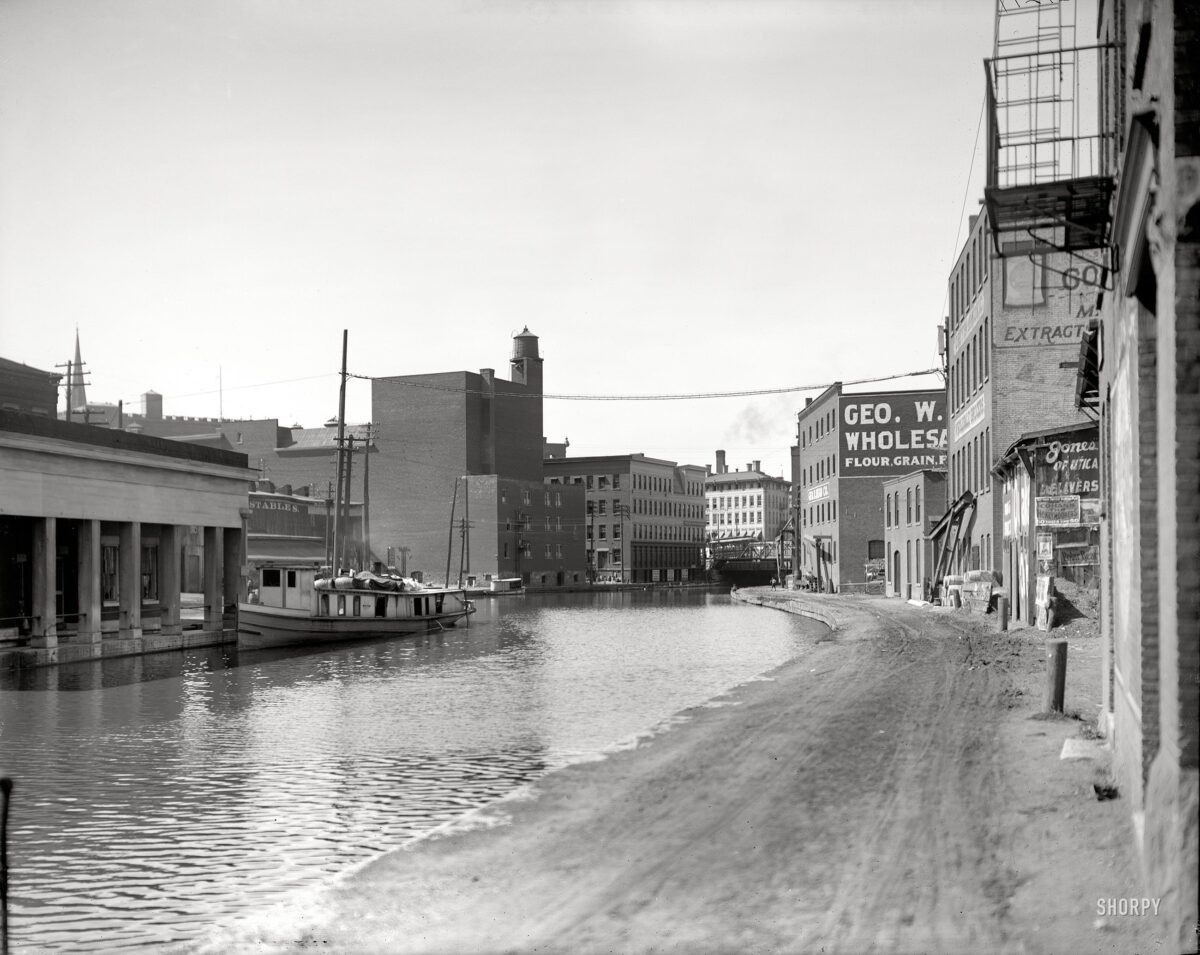
There is a street in Utica, New York called Erie Street, and the name is not accidental. Nothing in Utica is accidental when it comes to the canal. The Erie Canal made this city, shaped its neighborhoods, filled its churches, determined which languages would be spoken on which blocks, and drew to its banks the immigrant families who would spend the next century building the industrial heart of upstate New York. When Joseph Imhoff arrived from Bavaria in the mid-nineteenth century and settled his family at 85 Erie Street, he was not choosing a random address. He was planting himself at the center of the world the canal had created, in the middle of a German Catholic neighborhood whose very existence was the canal’s doing.

This is the story of that canal, that city, and that address.


The Big Ditch and the Men Who Dug It

The idea of connecting the Hudson River to the Great Lakes by a navigable waterway had been discussed since the 1780s, but it took one man’s political tenacity to make it real. DeWitt Clinton, former state legislator, U.S. Senator, mayor of New York City, and eventually governor of New York, believed that a canal through the Mohawk Valley would make New York City the economic capital of the young nation. His opponents ridiculed the project as “Clinton’s Folly” and “Clinton’s Big Ditch,” and President James Madison vetoed federal funding for it, calling it unconstitutional. Thomas Jefferson called it “madness.”

Construction began on July 4, 1817, near Rome, New York, breaking ground not far from the Oneida County communities where the Pryor and Imhoff families would later settle. The first fifteen miles, from Rome to Utica, opened in 1819, and the full 363-mile canal linking Albany on the Hudson River to Buffalo on Lake Erie opened on October 26, 1825. On that day, Governor Clinton boarded a canal boat at Buffalo called the Seneca Chief and began a ceremonial voyage east, arriving in New York Harbor nine days later, where he poured a barrel of Lake Erie water into the Atlantic Ocean in a ceremony he called “the Wedding of the Waters.”

What they had built was, at the time, the longest artificial waterway in North America, and one of the greatest engineering achievements in the world, made more remarkable by the fact that there were no formal engineering schools in the United States when construction began. The men who designed the route, James Geddes and Benjamin Wright, were judges whose primary experience in surveying had been settling boundary disputes. Canvass White was a 27-year-old amateur who persuaded Clinton to let him travel to Britain at his own expense to study canal construction. Nathan Roberts was a mathematics teacher and land speculator. These men and their crews carried the canal up the Niagara escarpment at Lockport, spanned the Genesee River on an aqueduct, and carved its path through solid rock between Little Falls and Schenectady, and all of it worked precisely as planned.

The laborers who dug it worked eight years through wet, hot, and freezing conditions, felling trees and excavating mile after mile mostly with hand tools and animal power. Some were Irish immigrants. Most were U.S.-born men from the farms and towns of upstate New York. They invented equipment to remove stumps and developed hydraulic cement that hardened underwater. They were building something none of them fully understood, and they built it well.


What It Did to the Country

The numbers tell part of the story. Before the Erie Canal, shipping a ton of freight from Buffalo to New York City cost approximately $100 and took about a month. After the canal opened, the same journey cost under $9 and took less than a week. Within a few years, annual freight on the canal eclipsed trade along the Mississippi River, amounting to $200 million, which would be worth more than $8 billion today. By 1853, the Erie Canal carried 62 percent of all U.S. trade. The $7 million cost of construction was fully recouped in toll fees alone within a few years of opening.

The canal transformed New York City from a significant port into the nation’s dominant economic power. The city’s population quadrupled between 1820 and 1850. Financing the canal’s construction allowed the city to eclipse Philadelphia as the country’s most important banking center. The canal provided a direct water route from the Atlantic coast to the Midwest, triggering large-scale commercial and agricultural development and opening the western frontier to settlement at a speed that would not have been possible otherwise. It also carried something harder to measure: ideas. Abolitionism, women’s suffrage, utopian experiments, and religious revivals all found fertile ground along the corridor. The Erie Canal transported more westbound immigrants than any other trans-Appalachian waterway, bringing new languages, customs, and traditions that helped shape the nation.

Abraham Lincoln, as a young politician in Illinois, dreamed of becoming “the DeWitt Clinton of Illinois.”


What It Did to Utica

The transformation of Utica was so dramatic that it reads, in retrospect, almost like something planned, though nothing about it was. The city, known as Old Fort Schuyler until 1798, had been a frontier settlement, a stopping point on the road west, with perhaps 3,000 inhabitants in 1820. It sat at precisely the right geographic moment on the Mohawk Valley corridor, the only natural cut through the Appalachians north of Alabama, and when the canal arrived it became something else entirely.

The first stretch of canal, from Rome to Utica, opened in 1819, and the impact was immediate. Utica’s population grew by 183 percent in the 1820s alone. By 1900, the city’s population had reached 56,000, making it the most rapidly growing city in New York State across that span. The canal did not merely bring commerce. It brought manufacturing. The two arrived together: cheap transportation made production profitable, and the profits financed expansion. A partial list of industries that established themselves in Utica in the canal era tells the story: grist mills and iron foundries in 1823, pottery works in 1826, engine and boiler works in 1832, oilcloth factories in 1832, steam planing mills in 1834, ready-made clothing in 1836, stoves and furnaces in 1842, woolen goods in 1847, cotton cloth in 1848, and knit goods in 1863, the beginning of the textile industry that would define Utica’s economy for the next century.

The Chenango Canal, completed in 1836, connected the Erie Canal at Utica to Binghamton and the anthracite coal fields of northeastern Pennsylvania, and coal became the fuel that kept the new factories running. The canal had created not just a city but an industrial system, and Utica sat at its intersection.


The Immigrants the Canal Brought

The canal did not merely carry goods. It carried people.

The wave of Irish immigrants who came to dig the canal in 1817 were among the first, and they settled along its banks when the digging was done. Then came the immigrants who rode the canal west, and stopped. Then came the immigrants drawn by the factory jobs the canal’s commerce had created, the Germans and the Irish and later the Italians and Poles and Syrians who filled Utica’s neighborhoods through the nineteenth and early twentieth centuries.

The Irish came first in significant numbers. Waves of Irish immigrants came to Utica to help construct the Erie Canal in 1817, and the growing village soon became a stopover of importance. Thousands more Irish and German immigrants, brought by the completed canal, transformed the ethnic and religious composition of Utica and pushed the population from 3,000 in 1820 to 56,000 in 1900.

The Germans came somewhat later. Although Germans were among Utica’s earliest settlers, they did not become numerous and prominent until the 1850s, when a substantial number of “Forty-Eighters,” refugees from the failed liberal revolutions of 1848, and other immigrants primarily from southwestern Germany settled there. By 1910, Germans constituted the largest ethnic group in Utica, supporting several churches, a major German-language newspaper, and many social organizations, among them the Utica Maennerchor, founded in 1865, and the brewing operation that would eventually become the F.X. Matt Brewing Company, dating back to 1888, both of which survive as reminders of the major role Germans played in Utica at an earlier time.

Those German immigrants needed a church. Around the time they began arriving in numbers to work on the Erie and Oswego canals, the German Catholic community of Utica organized itself around what would become St. Joseph’s Church. The present church at 704 Columbia Street was built in 1871, in the German Romanesque style, 180 feet long, with stained glass windows by the Tyrolese Art Glass Company of Innsbruck, Austria. It is now listed on the National Register of Historic Places. It was the spiritual center of the German Catholic world in Utica, and it was the world into which Joseph Imhoff settled when he arrived from Bavaria.


Erie Street and the World It Named

Erie Street in Utica is named for the canal it runs alongside in spirit and in proximity. In the second half of the nineteenth century, the streets nearest the canal’s path through Utica were working-class immigrant neighborhoods, the kind of blocks where you could walk a hundred yards and hear three languages, where the parish church was the organizing institution of daily life, and where the families who had arrived with nothing were building something in the particular way available to them: through labor, through faith, through community, and through the stubborn accumulation of ordinary days.

85 Erie Street was the home of Joseph Imhoff and Louisa Gentz Imhoff and their children. Joseph had been born in Bavaria on September 26, 1849, and had emigrated to Oneida County as part of the sustained German migration that filled Utica’s neighborhoods through the 1850s, 1860s, and 1870s. He married Louisa Gentz, born February 21, 1852, in Saxony, and they built their household on Erie Street in the heart of the German Catholic community centered on St. Joseph’s Church. They were precisely the people the Erie Canal had made possible, immigrants drawn to a city that would not have existed in its industrial form without the waterway that gave their street its name.

Joseph Imhoff lived an extraordinary 87 years, dying on February 18, 1937, at St. Elizabeth’s Hospital in Utica, the same hospital the German Catholic community had founded in a tenement house on Columbia Street in 1866. He had watched the city transform from a canal town into a manufacturing powerhouse and then begin its long, slow transition away from the industries that had built it. Louisa died on December 18, 1929, at 85 Erie Street, at age 77, seven weeks after the stock market crash that ended the era of prosperity she had spent her working life inside. Their son John Frederick Imhoff, born in 1881, grew up on Erie Street and came of age in a Utica that was still very much the city the canal had built.


The Canal’s Long Decline

The Erie Canal was enlarged twice to accommodate wider and deeper boats, and a substantial rerouting was completed in 1918 as the New York State Barge Canal system, which canalized natural waterways like the Mohawk and Seneca Rivers to create a modern commercial route. But the decline had been long in the making. By the end of the 1800s, railroads had begun to outpace the canal as the primary means of transportation. The Utica, Clinton, and Binghamton Railroad arrived in 1866. The New York Central served the city with multiple lines. The canal that had made Utica now shared its function with a rail network that could operate year-round, regardless of ice.

Commercial and shipping traffic declined abruptly after the completion of the St. Lawrence Seaway in 1959, which gave ocean-going vessels direct access to the Great Lakes, bypassing the canal entirely. The 1954 opening of the New York State Thruway, which bypassed the city of Utica, compounded the economic damage. Mill after mill shut down in the postwar decades. General Electric and Lockheed Martin closed their Utica plants in the 1980s and 1990s. The city that the canal had built in a generation contracted across the latter half of the twentieth century in the way that Rust Belt cities contract, gradually and then all at once.


What Remains

The canal itself still exists, though tourism is now its main source of traffic. The towpath that mules once walked is a 365-mile bike path. The locks that lifted and lowered boats across the elevation changes of upstate New York still operate, maintained as a National Heritage Corridor administered by the National Park Service. The Erie Canal was designated a National Heritage Corridor by the U.S. Congress in 2000, a recognition that what it represented was worth preserving even after its commercial function had passed.

The Utica Canal Terminal Harbor is still connected to the Erie Canal and the Mohawk River. The streets of the old canal neighborhoods still carry the names they were given in the canal era: Erie Street among them.

And 85 Erie Street still exists, though the world Joseph and Louisa Imhoff inhabited there is long gone. The German Catholic neighborhood around St. Joseph’s Church has changed beyond what either of them would recognize. The church itself still stands on Columbia Street, in the German Romanesque style, the Tyrolese windows still intact, listed on the National Register of Historic Places. The hospital that the German Catholic Franciscan sisters founded in 1866, St. Elizabeth’s, where Joseph Imhoff died in 1937, still operates as St. Elizabeth’s Medical Center.

Erie Street still runs through Utica. The canal is still there, reduced to a recreational waterway but physically present, the water still moving through the locks that the amateur engineers and the hand-tool laborers of 1817 first designed. The address 85 Erie Street carries in its name the full weight of what the canal did: it named a street, and the street named a neighborhood, and the neighborhood drew a German immigrant family from Bavaria, and that family built its American life at that address across three generations, and the imhoff.us archive preserves their names today.

DeWitt Clinton poured Lake Erie water into the Atlantic Ocean in November 1825 and called it “the Wedding of the Waters.” What he had really done was create the conditions under which a Bavarian farmer named Caspar Imhoff would send his son Joseph across an ocean to a city that would not have been there without the canal, to a street that bore the canal’s name, to build a life that the canal had made possible.

The canal did not merely connect Albany to Buffalo. It connected Frammersbach, Bavaria to 85 Erie Street, Utica, New York.


This article was compiled from records in the imhoff.us genealogical database, the Clinton Historical Society archives, the Landmarks Society of Greater Utica, and historical research into the Erie Canal and the city of Utica. If you have photographs, documents, or personal memories related to the Imhoff family of Utica or to any of the families documented in this archive, contributions are welcomed through the Contact page.

Gathering on the Hill: The Pryor Family Reunions of Kirkland, 1919 to 1938

By the imhoff.us Archive


Every summer, for twenty years, they came back.

They came from Clinton and Utica and Rome, from Newport and Middleville and Herkimer, from Whitesboro and New Hartford and Syracuse and, in some years, from as far as New York City and Bridgeport, Connecticut. They came by automobile along the roads of Oneida County on August Sunday afternoons, carrying covered dishes and dressed in their summer clothes, and they gathered on a lawn or in a grove or at a set of athletic fields that bore the family name, and they ate together and ran races and elected officers and reported on the births and deaths and marriages of the year just passed, and then they went home again and waited for the following summer.

The Pryor family reunions, held annually from 1919 to 1938, were documented in the pages of the Clinton Courier, the Waterville Times, and the Utica Daily Press. They are, taken together, one of the most vivid records in the imhoff.us archive of what it meant to be an Irish Catholic family in Oneida County in the years between the two World Wars. They are also a record of how a family that had arrived from the Famine ships in December 1853 had, within two generations, become so thoroughly rooted in the soil of Kirkland and Clinton that they had athletic fields named after them and a hundred relatives within driving distance every August.

What follows is as complete an account of those twenty reunions as the surviving newspaper record permits.


The Family That Gathered

To understand the reunions, it helps to understand the family that held them.

James Daniel Pryor was born in Ireland on March 16, 1830, the son of John Pryor and Anne Kiernan. He married Margaret Robinson, also born in Ireland in 1833, at Saint Mary’s Church in Clinton on January 8, 1853, and the two of them stepped off the ship James Fitz in New York Harbor on December 19 of that same year. They settled in the Kirkland area near the iron works, embedded themselves in the Irish Catholic community forming around St. Mary’s Church on Marvin Street, and set about building a family.

James Daniel and Margaret Robinson had eight children, all born in the United States, between 1855 and 1877:

Thomas J., born April 27, 1855, died July 15, 1930. John, born August 13, 1856, died March 14, 1904. William Christopher, born July 27, 1859, died June 15, 1930. Margaret E., born November 4, 1863, died March 13, 1958. Edward Patrick, born September 8, 1870, died October 18, 1871, in infancy. Daniel Henry, born April 20, 1872, died September 15, 1953. Emma, born April 10, 1876, died November 26, 1877, also in infancy. And Mary Elizabeth, known as Minnie, born October 13, 1877, died December 27, 1950.

Six children survived to adulthood, and their children and grandchildren were the people who filled the lawns and groves of Kirkland every August through the 1920s and 1930s. By 1919, when the first reunion was held, those descendants had spread across a substantial portion of upstate New York, in a dozen communities connected by the roads and railroads of Oneida County, and held together by the bonds of faith, blood, and the particular kind of Irish Catholic community loyalty that St. Mary’s had been building since the 1850s.

Margaret Robinson Pryor died in 1898, twenty-one years before the first reunion was held. James Daniel lived to see it. He was 89 years old in the summer of 1919, a man born in Famine Ireland who had spent 66 years watching his family grow from two immigrant newcomers into a community that needed a hundred chairs to seat itself.


The First Reunion: August 17, 1919

The summer of 1919 was a complicated one in American life. The Great War had ended the previous November, and the boys of Kirkland and Clinton were coming home. Woodrow Wilson was in Europe trying to negotiate a peace that Congress would ultimately refuse to ratify. Race riots had broken out in Chicago and other American cities in what historians would call the Red Summer. Prohibition was less than a year away from taking effect. The country was in one of those transitional moments when one era has ended and the next has not yet fully arrived.

None of this, or very little of it, would have been the subject of conversation at Thomas Pryor’s farm on Pryor Road off the Seneca Turnpike in Kirkland that Sunday afternoon. What mattered was the family, and the family was there. Eighty guests attended this first reunion, served dinner in the dancing hall given that the weather, as the newspaper account noted, was inclement on this day.

The entertainment was entirely homemade, in the way of the era. Miss Veronica Pryor sang vocal solos. Stanley and Mrs. Autenrith performed a violin and cornet duet. Mrs. Lawrence Seavey played piano solos. Master Terence Autenrith also sang. The Autenrith family appeared repeatedly in the reunion records, connected to the Pryors through the marriage of James Daniel’s sister, Mary Pryor, to Jacob Autenrith in 1860. They were family, in the full Irish Catholic sense of the word.

Thomas Pryor, the host, was the eldest surviving son of James Daniel and Margaret Robinson. He had been born in April 1855, two years after his parents arrived from Ireland, the first American-born Pryor, a man whose very existence measured the distance the family had traveled from the Famine ship to the Kirkland farm. His decision to open his home and his farm to the extended family that summer of 1919 was an act of both hospitality and civic memory, a declaration that these people, scattered now across a dozen communities, were still one family and would gather to say so.


The Middle Years: Finding a Pattern, 1920 to 1925

The newspaper record has gaps. The reunions of 1920, 1921, 1922, 1923, and 1924 are not covered in the surviving press accounts available to the archive. We know they were held, because the record refers to the 7th annual reunion in 1925, counting back from a first in 1919. We know that James Daniel Pryor, the patriarch whose very existence had given the whole enterprise its meaning, died on October 16, 1921, at the age of 91, at the family home in Lairdsville, Oneida County. The Clinton Courier noted his passing, calling him “one of the pioneer residents and one who enjoyed the esteem and respect of all who knew him.” He had lived long enough to see the first gathering of his descendants. He did not live to see the seventh.

By 1925, the reunion had established the format it would keep for the rest of its run. A hundred guests. A Sunday in August. Dinner on the lawn when the weather permitted. A formal meeting with elected officers, a report on the year’s births and deaths and marriages, and races and prizes for the children. It was, in structure, half church social and half county fair, the kind of event that small-town Irish Catholic families in upstate New York had been organizing since they first had enough relatives to fill a field.


The 7th Annual Reunion: August 1925

The Clinton Courier of Wednesday, August 12, 1925 carried the account of the 7th annual Pryor Family reunion, held at the home of James Pryor, the youngest son of James Daniel and Margaret Robinson.

One hundred guests attended, drawn from Clinton, Utica, Kirkland, Sherrill, Newport, New Hartford, Norwich, Herkimer, Rome, Syracuse, Middleville, Whitesboro, Mohawk, and New York City. The geographic spread of that list tells its own story. The Pryor family had moved in every direction from the original Kirkland farm, following employment and marriage into the mill towns and manufacturing cities of upstate New York, and some had gone much further, to New York City and Connecticut. But they came back in August.

Officers elected at the 1925 reunion were: President, Thomas Jones; Vice President, Mrs. Arthur Peterson; Secretary, Miss Florence Caraher; Secretary, Jacob Autenrith; and Miss Margaret E. Pryor, chairman of the flower committee.

Miss Margaret E. Pryor, the daughter of James Daniel and Margaret Robinson born during the Civil War in 1863, would appear in these reunion records with admirable regularity across the following decade, serving as flower committee chair, historian, and simply as a presence, the living link to the generation that had arrived from Ireland. She was 61 years old at the 1925 reunion, and she would attend them into the 1930s.

Three deaths and one birth were reported for the year. Rita Mary Sheridan, daughter of Mr. and Mrs. John Sheridan, received a prize as the youngest person present. The family voted to hold the eighth reunion at the home of Mrs. John Pryor on College Street in Clinton.

The mid-1920s was the height of the Jazz Age in America. Calvin Coolidge was in the White House. The Charleston was on every dance floor. F. Scott Fitzgerald had just published The Great Gatsby. Al Capone was running Chicago. None of that particular American modernity was likely the soundtrack of the Pryor reunion on the Kirkland lawn, where the entertainment leaned toward family music and the conversations leaned toward local news. But the prosperity of the era, what Coolidge called the “business of America,” was real in Oneida County too. The families who gathered in 1925 were doing well enough, employed in the mills and farms and trades of the region, and the hundred guests who made the drive to Kirkland that August Sunday were evidence of it.


The 8th Annual Reunion: August 15, 1926

Despite the vote to hold the eighth reunion at the home of Mrs. John Pryor on College Street in Clinton, it was held instead at the “Pryor Athletic Fields,” thought to be located on Pryor Road just off of the Seneca Turnpike near Route 233. The change of venue may reflect the size of the gathering, since a hundred people require a good deal more lawn than most private homes could provide.

Articles about the reunion appeared in the Wednesday, August 19th editions of both the Clinton Courier and the Waterville Times, a sign that the family reunion had achieved sufficient community standing to warrant coverage in two local papers simultaneously.

The guest list recorded in the newspaper is the most complete of any reunion in the archive, a remarkable snapshot of the extended Pryor family and its connected surnames in the summer of 1926:

Miss Margaret E. Pryor, Clinton. Mr. and Mrs. Daniel Pryor and family, Clinton. William Pryor and Miss Theresa Pryor, Clinton. Mr. and Mrs. John E. Pryor and Family, Clinton. Mr. and Mrs. Thomas Pryor, Clinton. Mr. and Mrs. Vincent Pryor and Family, Clinton. Mr. and Mrs. Charles Pratt and family, Utica. Mrs. Martin Caraher and Family, Utica. Donald Dolan, New York. Neal Pryor, Whitesboro. Mr. and Mrs. James J. Dwyer and family, Utica. Mr. and Mrs. William Pryor, Kirkland. Mr. and Mrs. Jacob Autenrith and family, Newport. Miss Catherine C. Connelly, Port Richmond. Mr. and Mrs. Peterson and family, New Hartford. Mr. and Mrs. O’Toole and family, Utica. Mrs. Stanley O’Toole, Utica. Miss Anne O’Toole, Utica. James Pryor, Bridgeport, Connecticut. Mr. and Mrs. Matt Kernan and family, Rome. Mr. and Mrs. William Autenrith and family, Middleville. Miss Amelia and Miss Minnie Autenrith, Middleville. Mr. and Mrs. Louis Remmer, Utica. Mr. and Mrs. Thomas Jones and Family, Utica. Miss Mattie and Miss Anna Pryor, Utica. Mr. and Mrs. John Sheridan and family, Clinton. Mr. and Mrs. Francis Feeney, Utica.

The surnames in that list are the surnames of the Pryor world: Pryor, Autenrith, Caraher, O’Toole, Sheridan, Dwyer, Kernan, Feeney. Irish Catholic names, all of them, the product of the same Famine-era emigration that had brought James Daniel and Margaret Robinson to Kirkland in 1853, and all now resident in the communities within a day’s drive of the Pryor Athletic Fields. One guest, James Pryor of Bridgeport, Connecticut, had traveled the furthest, a branch of the family that had moved entirely out of Oneida County.


The 9th Annual Reunion: August 21, 1927

The ninth annual Pryor Reunion returned to the Pryor Family Athletic Fields on Pryor Road on Sunday, August 21, 1927. The account of the reunion appeared in the Tuesday, August 23rd edition of the Utica Daily Press, which noted that 100 individuals were present.

The summer of 1927 was the summer Charles Lindbergh flew the Atlantic alone, landing in Paris on May 21 to a reception that made him the most famous man in the world. Babe Ruth was on his way to hitting 60 home runs. Al Jolson’s The Jazz Singer would open in October, ushering in the era of talking pictures. The prosperity of the decade felt permanent to most Americans that summer, and the families gathering on Pryor Road had little reason to think otherwise.


The 10th Annual Reunion: August 19, 1928

The 10th annual Pryor reunion marked a return to a private home, held on Sunday, August 19, 1928 at the home of Daniel Pryor on Kirkland Hill. Daniel Henry Pryor, the sixth child of James Daniel and Margaret Robinson, born in 1872, was now 56 years old and living on Kirkland Hill, and his home would serve as the reunion’s primary venue for much of the remainder of the series.

An account appeared in the Wednesday, August 22nd, 1928 edition of the Clinton Courier. Approximately 80 individuals were present, a smaller gathering than the hundred who had appeared in the years at the Athletic Fields, but the list of communities represented remained broad: Newport, Herkimer, Utica, Clinton, New Hartford, Kirkland, Rome, and Syracuse.

The summer of 1928 was the last summer of American prosperity for a long time. Hoover would win the presidency in November, and the stock market was still climbing. No one at Daniel Pryor’s reunion that August Sunday had any reason to know that in a little over a year, the world would change entirely.


The 11th Annual Reunion: August 18, 1929

The 11th annual Pryor reunion was held on Sunday, August 18, 1929, again at the home of Daniel Pryor on Kirkland Hill, and the Clinton Courier of August 22, 1929 gave it its fullest account in years.

“The weather was ideal,” the paper noted, “and tables were set up on the spacious lawn.” At noon, a “bountiful” dinner was served, after which a meeting was called to order by the president, Edward O’Toole of Utica. The business of the reunion was conducted with the formality that these gatherings had developed over a decade: officers were elected, committees formed, prizes awarded, and the year’s vital statistics recorded.

Officers chosen were: President, Edward O’Toole; Vice President, Thomas Jones of 1015 Churchill Avenue, Utica; Secretary, Mrs. A.N. Peterson of New Hartford; Treasurer, Jacob Autenrith of Middleville. The entertainment committee was composed of Mr. and Mrs. William Pryor, Kirkland; Mr. and Mrs. John Sheridan, Clinton; and Miss Florence and Harold Caraher, Utica. The sports program was in charge of Edward O’Toole, Thomas Jones, and James Dwyer.

The prizes and races give the most vivid picture of what the afternoon actually felt like. Secret time race for women: Mrs. Julia Allen, Sauquoit. Marshmallow race: Mrs. Daniel Pryor, Kirkland Hill. Peanut race: Mrs. John E. Pryor, Clinton. Time race for men: John Toomey, Utica. Running race for men: William Pryor, Kirkland. Little girls’ race: Rosemary O’Toole, Utica. Little boys’ race: Lysle Pryor, Clinton. Prize for youngest baby: little Ann Feeney, Utica.

A marshmallow race and a peanut race, a running race for men and a prize for the youngest baby. These are the details that the newspaper preserved, almost by accident, and that nothing else would have saved. The afternoon on Daniel Pryor’s lawn in August 1929 is alive in those small particulars in a way it would not be if the account had only recorded the officers and the guest list.

Report was given of one death, two births, and two weddings. Guests were present from New York City, Bridgeport, Newport, Middleville, Herkimer, Utica, Whitesboro, Clinton, New Hartford, Rome, and Syracuse. The next reunion was planned for Newport.

Two months and nine days after this reunion, on October 29, 1929, the stock market crashed. Black Tuesday ended the prosperity of the decade and sent the American economy into the spiral that would define the 1930s. The families who had gathered so contentedly on Daniel Pryor’s lawn in August would spend the next years navigating the Depression in the mill towns and farming communities of Oneida County.


The Depression Years: Reunions 12 Through 16, 1930 to 1934

The reunions continued through the Depression without interruption, which is itself a statement about the Pryor family’s priorities and, perhaps, about the function the gatherings served. In hard times, a day spent with a hundred relatives on a familiar lawn, eating a potluck dinner and watching the children run races, is not a luxury. It is a necessity of a different kind.

The 12th reunion details are not preserved in the available newspaper record, but the 13th annual Pryor reunion, held at the home of Daniel Pryor on Sunday, August 16, 1931, appears in the archive. A basket picnic was served, a modest step down from the “bountiful dinner” of 1929, perhaps reflecting the economic strains of the era. In the afternoon, a meeting was called by the president, Daniel Pryor, and officers were elected: President, Daniel Pryor, Kirkland; Vice President, J.E. O’Toole, Utica; Treasurer, J.B. Autenrith, Newport; Secretary, Katherine L. Jones, Utica.

Races were run and prizes were awarded to Maureen O’Toole, Mrs. Frank Pryor, Eunice Volmer, Harry Pryor, Donald Pryor, and Francis Feeney. One death and one birth were reported during the year. The family voted to hold the following year’s reunion at the same place, Daniel Pryor’s home on Kirkland Hill, which had by now become the de facto permanent home of the gathering.

The 14th annual Pryor reunion was held on Sunday, August 21, 1932, at the home of Daniel Pryor. A luncheon was served at noon. Officers elected were: President, James J. Dwyer, Utica; Vice President, Mary E. Pryor, Utica; Secretary, Kathryn Jones, Utica, and Jacob Autenrith, Newport. The entertainment committee was Mr. and Mrs. Louis Remmer and Mr. and Mrs. James Dwyer. The sports committee was Edward O’Toole and Thomas Jones. Prizes were won by Stanley Autenrith, Mrs. Vincent Pryor, Rita Sheridan, Alice Volmer, Shirley Volmer, Harold Pryor, and Harry Pryor.

By 1932, Franklin Roosevelt was running for president on the promise of a New Deal. Unemployment had reached 23 percent nationally. Oneida County’s mills were running reduced shifts or not at all. The families gathering at Daniel Pryor’s that August Sunday were living through the worst of it, and still they came.

The 16th annual reunion was held at the home of Daniel Pryor in Kirkland on Sunday afternoon, August 18, 1934. Officers elected: President, Daniel Pryor; Vice President, Roy Caraher, Utica; Secretary, Miss Kathryn L. Jones, Utica; Treasurer, Jacob B. Autenrith, Newport. Plans were made to hold the 1935 reunion at the home of Mr. and Mrs. J.B. Autenrith in Newport, marking a rare departure from Kirkland Hill.


The 18th Annual Reunion: August 16, 1936

The 18th annual Pryor reunion was held at Newport Grove on August 16, 1936, a departure from the usual Kirkland Hill setting that suggests the Autenrith branch of the family was taking a larger role in the organization.

Officers named were: President, Daniel Pryor, Kirkland; Vice President, Roy Caraher, Utica; Secretary, Mrs. Kathryn L. Jones, Utica; Treasurer, Jacob Autenrith, Newport; and, notably, Historian, Miss Margaret Pryor of Kirkland.

The addition of a formal “Historian” role to the reunion’s officer slate is significant. By 1936, the reunion was in its eighteenth year, James Daniel Pryor had been dead for fifteen years, and the generation that remembered him as a living presence was aging. The decision to name a Historian, charged with preserving the family’s memory, was an acknowledgment that the story needed tending. Miss Margaret Pryor of Kirkland accepted that responsibility.

Plans were made to hold the 19th reunion at the home of Daniel Pryor in Kirkland on August 15, 1937.

The summer of 1936 was the summer Jesse Owens won four gold medals at the Berlin Olympics, humiliating Hitler’s racial ideology on the world stage. In America, the New Deal was being contested in the courts and celebrated at the ballot box. Swing music was everywhere. Benny Goodman had played Carnegie Hall for the first time. The families gathering at Newport Grove that August Sunday were living in a decade that was both deeply troubled and unexpectedly vital, and the reunion, in its modest annual persistence, was its own form of vitality.


The 20th and Final Reunion: August 27, 1938

The 20th Pryor reunion was held at the home of Daniel Pryor in Kirkland on Saturday, August 27, 1938, a Saturday rather than the traditional Sunday, a small departure from the established pattern.

Forty guests were present, a significant reduction from the hundred who had gathered through the 1920s. The Depression, combined with the aging and death of the founding generation, had taken its toll on the family’s ability to turn out in strength. Thomas J. Pryor, the eldest son of James Daniel and Margaret Robinson and the host of the very first reunion in 1919, had died in 1930. William Christopher Pryor had also died in 1930. The generation that had founded the tradition was passing.

Officers elected for the following year’s reunion: President, Daniel Pryor; Vice President, Thomas Jones; Treasurer, Jacob Autenrith; Secretary, Florence Caraher; Historian, Margaret Pryor.

This was the last reunion covered by the local newspapers. No record exists of a 21st reunion. Whether the outbreak of World War II in Europe in September 1939, or the changing circumstances of the family, or simply the natural attrition of a tradition dependent on the energy of a particular generation, the Pryor Family reunions came to an end somewhere between 1938 and 1940. They had run for twenty years.


What the Reunions Were

There is a comment in the imhoff.us archive, posted in December 2018 by Mary Lou Studley Newstead, that reads: “I am a descendant of John Sheridan and Mary Pryor Sheridan. Rita Sheridan Studley is my mother and she is alive and well at 93 in Rochester, NY.”

Rita Sheridan, daughter of Mr. and Mrs. John Sheridan of Clinton, had been the youngest person present at the 7th reunion in 1925, receiving a prize for the distinction. She was born sometime around 1925, which means she was present at the reunion as an infant, held by her parents in the summer shade on Daniel Pryor’s lawn. She grew up to be 93 years old in Rochester, still remembered by her daughter, who found the imhoff.us archive and left a note.

That is what the reunions were. They were the mechanism by which a family that had arrived from Ireland with nothing, in December 1853, reproduced itself socially across the generations. The children who ran the little girls’ and little boys’ races in the 1920s and 1930s grew up knowing they were Pryors, knowing the names of their cousins from Utica and Rome and Newport, knowing the faces of the aunts and uncles who appeared each August on the familiar lawn. They carried that knowledge into their own lives and, in some cases, passed it to their children, who eventually found their way to a genealogical archive and left a comment.

James Daniel Pryor arrived in Clinton in December 1853. He and Margaret Robinson raised eight children on the soil of Oneida County. Those children and their children held twenty family reunions between 1919 and 1938, and the Clinton Courier recorded most of them. The archive preserves what the newspaper saved.

That is how a family stays a family across the generations: by gathering, by naming officers and flower committees, by running marshmallow races and awarding prizes to the youngest baby present, by reading the year’s list of births and deaths and marriages aloud to everyone who came, by doing this every August for twenty years on a hill in Kirkland, New York, until the world changed too much and the generation that had held it together was gone.


A Note on the Record

The reunion accounts are drawn from the following sources: the Clinton Courier, Wednesday editions of August 12, 1925; August 19, 1926; August 22, 1928; and August 22, 1929. The 9th reunion is documented in the Utica Daily Press, August 23, 1927. The 8th reunion also appeared in the Waterville Times, August 19, 1926. The first reunion account is preserved in the imhoff.us archive through the research of Joseph Daniel Pryor, whose gathering of family records forms the foundation of everything documented here about the Pryor line.

Gaps in the record, specifically the reunions of 1920 through 1924, the 12th, 15th, and 17th annual reunions, and the 19th annual reunion, reflect the limits of the newspaper archive rather than the absence of the events themselves. The full run of the Clinton Courier on microfilm is held at the New York State Library and the Utica Public Library. Any family member who locates additional reunion accounts in those archives is encouraged to contribute them to the imhoff.us archive through the Contact page.


This article was compiled from records in the imhoff.us genealogical database, newspaper accounts in the Clinton Courier, the Waterville Times, and the Utica Daily Press, and from the research of Joseph Daniel Pryor. If you are a descendant of any of the Pryor, Autenrith, Caraher, O’Toole, Sheridan, Dwyer, Kernan, or connected families documented in this article, the archive welcomes your contributions at the Contact page.


A Village That Remembers: Clinton, New York and the Pryor Family of Oneida County

By the imhoff.us Archive

There is a particular kind of American place that does not announce itself. It has no famous skyline, no monument that draws tourists, no single event so dramatic that it seizes the national imagination. What it has instead is continuity, the kind that accumulates in cemetery lots and church registers and the columns of a weekly newspaper, layer upon layer, generation upon generation, until the place itself becomes a kind of record. Clinton, New York, in Oneida County, is that kind of place.

The Pryor family of the imhoff.us archive found their way to Clinton in December 1853, and the last of them was buried in its churchyard in 2002. Between those two dates, 149 years of American life passed through this village: wars, epidemics, depressions, the slow death of industries, the quieter survival of faith and community. The Clinton Courier, the village’s weekly newspaper, was there for most of it, recording the names and the dates, the comings and the goings, the men who went to war and the families who waited. That is what small-town newspapers do, and it is why they matter.

This is the story of Clinton, and of the family that made it home.


The Village That Veterans Built

Clinton did not begin as an immigrant town. It began as a soldier’s town.

In March 1787, eight pioneers from Plymouth, Connecticut, led by Captain Moses Foote, a veteran of the Revolutionary War, pushed into the southern reaches of what would become Oneida County and staked their claim in the Oriskany Valley. The Founders’ Monument in the village green lists their names: Moses Foote, Barnabas Pond, Bronson Foote, Luther Foote, Ira Foote, James Bronson, Levi Sherman, and Ludim Blodgett. They had fought for a republic, and now they were building one from scratch, one farm at a time. The Seneca people had called the area Ka-dah-wis-dag, meaning “white field.” The Connecticut men called it Clinton, after New York’s first governor, George Clinton, fourth Vice President of the United States.

What they found was good soil, plentiful timber, and the Oriskany Creek running through it. What they built, within a single generation, was remarkable. By 1835, the town had two tanneries, a distillery, a trip hammer, two woolen mills, a cotton factory, six carding machines, two fulling mills, seven saw mills, and five grist mills, with a population of approximately 700 people. A community had taken root.

The village acquired something else in 1793 that would define its character for the next two centuries. Presbyterian minister Rev. Samuel Kirkland founded Hamilton-Oneida Academy as a seminary to serve as part of his missionary work with the Oneida tribe. The Academy became Hamilton College in 1812, making it the third oldest college in New York, after Columbia and Union. The presence of a college gave Clinton its reputation. Clinton was once known as the “village of schools” because many private schools operated there in the 1800s, and people in 1878 said that Clinton was a great place for education, helping to improve the community’s morals. A survey eventually identified more than 60 schools that had operated in Clinton between 1790 and 1915, from the celebrated Clinton Grammar School, where Grover Cleveland and Elihu Root received part of their educations, to small one-room schoolhouses scattered through the township’s farms. It was called, simply, “Schooltown.”

But education was only part of the village’s economy. Beneath the farms and the college green, Clinton sat atop something the original settlers had not anticipated. Iron ore was first discovered on the farm of James D. Stebbins on the easterly side of town in 1797, and the mineral deposits ran in a line through Oneida County starting in Verona and Westmoreland, where the line cut south through Kirkland and southeast to the Village of Clinton. That discovery would shape the lives of every working family in the township for a hundred and sixty years. From 1852 to 1964, the ore was mined in the town and used at the Franklin Iron Works and later at the Clinton Metallic Paint Co. The iron mines, and the furnaces that processed their ore, drew a different kind of resident to Clinton than the Connecticut farmers or the Hamilton College scholars, drawing men who worked with their hands, men willing to go underground or into the furnace heat for a wage, and among them, wave after wave of Irish immigrants.


The Newspaper That Watched It All

Before there was a Pryor in Clinton, there was a press.

The newspaper that would eventually become the Clinton Courier began as the Clinton Signal in July 1846, the work of one L.W. Payne. In 1848, certain members of the senior class of Hamilton College offered their aid to the paper and it was called the Radiator. This lasted only a year and the name was changed back to the Clinton Signal. Mr. Payne was joined by Ira D. Brown and the two established the Oneida Chief. In 1856 it was sold to Francis E. Merritt, who a year later sold it to Galen H. Osbourne, who changed the name to the Chief and Courier. In August of 1859 Mr. Osbourne sold the paper to M.D. Raymond, who continued to publish it until May 1, 1875, when he finally sold it to J.B. Sykes. Mr. Sykes changed the name to the Clinton Courier.

Under that name, the paper would run for nearly a century, until 1956, faithfully recording the life of the village through the Civil War, the Gilded Age, two World Wars, and the Depression. Its columns carried the births and marriages, the farm reports and college news, the lists of men gone to war and, in harder weeks, the lists of those who would not be coming back. When James Daniel Pryor died in October 1921, the Courier was there to note his passing, recording him as “one of the pioneer residents and one who enjoyed the esteem and respect of all who knew him.” That sentence is the kind of obituary a community writes for a man it actually knew. He had earned it across 68 years of living in its fields and pews and roads.


The Coming of the Irish: December 1853

James Daniel Pryor was born in Ireland on March 16, 1830, the son of John Pryor and Anne Kiernan. He grew up in a country being systematically destroyed.

The potato blight arrived in 1845. By the time it had run its course, more than one million Irish had died of starvation and disease, and another million had fled. The ships that carried the Irish to America in the late 1840s and early 1850s were crowded, dangerous, and often deadly. Those who survived the crossing arrived in New York Harbor with little more than the clothes they had worn for the voyage. The songs they carried with them, the ballads of exile and longing that would become the backbone of Irish American folk tradition, were among the only things that weighed nothing.

James Daniel Pryor survived all of it. He married Margaret Robinson, born in Ireland in 1833, on January 8, 1853, at Saint Mary’s Church in Clinton, New York, before they had even sailed. It was an act of faith, or perhaps of practical determination: they would begin American life already bound to each other, already belonging to the parish that would anchor their family for the next 150 years. On December 19, 1853, the couple stepped off the ship James Fitz in New York Harbor and made their way to Oneida County.

The America they arrived in was a country beginning to fracture. The Kansas-Nebraska Act was a year away. The Dred Scott decision was four years in the future. Uncle Tom’s Cabin had been published the previous year and was selling in numbers no American novel had ever reached. The country was arguing about slavery in a way that was moving beyond argument toward something worse. James and Margaret Pryor had left one catastrophe and were arriving at the edge of another, though they could not have known it.

What they found in Clinton was a church, a community, and work.

The iron mines, the building of the Chenango Canal, and later the knitting mills, brought many Irish settlers to the Clinton area. The first authentic account of the settlement of Catholics in Clinton is of a James McGuire and his family from Ireland, at whose home Mass was first celebrated. By the time James and Margaret arrived, the Irish Catholic community in Clinton was already taking shape around Saint Mary’s Church, and on April 30, 1851, a building lot for a church had been purchased from Judge Williams for $125 on the same site on Marvin Street upon which the present church stands. The Pryors walked into a community that was still building its own institutions, still planting its own roots. They fit exactly.

James Daniel established himself as a farmer, working the Oneida County soil that was not so different, in its demands, from the Irish land his family had worked for generations. They settled near Kirkland Iron Works, in the Clinton area, embedded in the tight Irish Catholic world of the parish. By the time the Clinton Courier was being established under that name in 1875, James Daniel Pryor was already a recognized member of the community, a man whose face was known on the roads into the village and in the pews of St. Mary’s.


The Civil War Years: Clinton Sends Its Men

The Clinton Courier and its predecessors would have carried a particular kind of news through the years 1861 to 1865.

Oneida County raised five infantry regiments of volunteers during the Civil War: the 14th New York Infantry, the 26th New York Infantry, the 97th New York Infantry, the 117th New York Infantry, and the 146th New York Infantry. The ten companies of the Fifth Oneida were principally recruited from local towns, with Company G drawn from Clinton, Kirkland, Bridgewater, and Plainfield.

James Daniel Pryor had been in America for less than a decade when the war began. He was 31 years old, a farmer with a young family, a man who had already survived the Famine and the crossing and the hard work of building a life from nothing. Whether he or any of the extended Pryor and Robinson network around him served in uniform, the records do not definitively confirm. But the war was impossible to be unaware of. The men of Company G, his neighbors and fellow parishioners, marched out of Clinton and Kirkland and went south. The 146th New York, the Fifth Oneida, lost staggering numbers. The Fifth Oneida left Rome for Washington, DC in October 1862 with approximately 850 men. When the unit was mustered out of service on July 16, 1865, 264 were accounted for. When the regiment paraded through Utica in late July 1865, only 120 were on hand.

The Courier would have published their names. The Clinton community would have known every one of them. James Daniel Pryor, Irish-born farmer of the Kirkland area, would have read those columns, or heard them read, in the years when the village held its breath and waited to learn who was coming home.

The Old Burying Ground in Clinton holds the graves of 48 Revolutionary War veterans and many other local historical figures. After the Civil War, the cemetery filled further. Clinton knew the cost of war in the way that small towns know it: not as a statistic but as a name, a face, a pew left empty.


Margaret E. Pryor: A Life That Spanned the Centuries

Among the children James Daniel and Margaret Robinson Pryor raised in Westmoreland and Clinton was a daughter born November 4, 1863, in Westmoreland, Oneida County. They named her Margaret, after her mother.

She was born the year Lincoln signed the Emancipation Proclamation. She was born as the Fifth Oneida was fighting its way through the Virginia campaigns that would end the war two years later. She was, in every sense, a child of the Civil War era, born into a village and a family that were living through the defining catastrophe of nineteenth century America from the remove of an Oneida County farm.

Margaret E. Pryor lived for 94 years. She died on March 13, 1958, at the Summit Nursing Home in Utica, New York, the same year the Soviet Union launched Sputnik and the space age began in earnest, the same year Elvis Presley was drafted into the United States Army and Chuck Berry recorded “Johnny B. Goode.” She had been born in Lincoln’s America and she died in Eisenhower’s.

In between, she had witnessed the entire arc of the country’s industrial transformation, the closing of the frontier, the Gilded Age, the progressive era, two World Wars and the Korean War, the Great Depression, the rise of the automobile, the invention of radio and television and the long slow modernization of the Oneida County world she had been born into. She appears in the records as a woman of Westmoreland and Clinton, unmarried, whose life was embedded in the same parish and farming community as her parents and siblings. She was, in the way of many women of her era and class, invisible to history but essential to the family around her, a constant presence in the background of the records her brother Daniel Henry and nephew James Houston left behind.

When she died at 94, the Courier, or its successor paper, almost certainly noted her passing. She was, by then, one of the last living threads back to the world James Daniel and Margaret Robinson Pryor had built from scratch in 1853. Her death closed a chapter of the Pryor story that had opened when her parents stepped off the James Fitz into New York Harbor.


Daniel Henry Pryor: The Generation That Stayed

Born April 20, 1872 in Westmoreland, Oneida County, Daniel Henry Pryor was the second generation of the American Pryor line. He never left.

He came of age during the Gilded Age, a period that the Clinton Courier would have covered with the mix of local boosterism and farm news and social columns that defined small-town weekly journalism of the era. He was growing up as the iron mines around Kirkland were in full operation, as the knitting mills in Clark Mills were humming, as the Utica, Clinton, and Binghamton Railroad, which had arrived in Clinton in 1866, was still carrying passengers and freight through the township.

He would have been a young man when the Courier reported on the Spanish-American War of 1898, and middle-aged when the paper’s columns would have been heavy with the names of the young men of Clinton and Kirkland going to the Western Front in 1917 and 1918. He was 46 years old when the Armistice was signed on November 11, 1918, and the church bells rang across Oneida County. “Over There,” the George M. Cohan song that had sent a generation to war, had been the marching tune of the year. Now it was over, and Daniel Henry was still in Kirkland.

He lived until September 15, 1953, dying at age 81 at Kirkland Iron Works, the iron industry that had drawn his parents’ generation of Irish immigrants still operating, barely, into the middle of the twentieth century. He died the year Stalin died, the year the Korean War ended, the year From Here to Eternity was in movie theaters. A quiet, rooted life, spent in the county where his parents had arrived as strangers seventy years before.


The Great War and Its Shadow

The Clinton Courier of 1917 and 1918 would have been a paper of a particular kind of grief.

Oneida County sent its young men to France as it had sent them to the Wilderness and Gettysburg half a century before. The names in the paper were now names like Pryor and Welch and McCabe, Irish names mingled with the Italian and Polish names of the newer immigrant communities that had been filling Utica’s neighborhoods since the 1880s. Clinton was still, in 1917, a predominantly Anglo-Protestant village, but the Irish Catholic community of St. Mary’s was thoroughly woven into its fabric by then, and the parish rolls of the war years carried their share of names from among the families that had arrived from the Famine ships in the 1850s.

The 1920s came next, the decade of contradictions. Prohibition, the rise of the Klan in upstate New York, the jazz age, the Model T, and the radio. James Houston Pryor, Daniel Henry’s son, was a teenager in the 1920s, and the Clinton Courier of those years would have covered the same mix of college news, farm reports, and local politics it always had, with perhaps a new note of the century’s novelty, advertisements for automobile dealers and radio dealers and the other equipment of modernity beginning to appear alongside the older notices for harness shops and seed merchants.

James Houston was born on April 5, 1907, in Clinton, the same year Oklahoma became the 46th state. He grew up hearing Scott Joplin’s ragtime on phonograph cylinders and came of age as jazz was taking over American popular music. When he married Lorretta Mary Welch on October 28, 1936, at St. Mary’s Church, the witnesses were Joan McCabe and Howard Clute, names that appear in the Clinton parish records as solidly as the Pryors themselves. The Welch family had been woven into the same Irish Catholic community for as long as anyone could remember. Benny Goodman’s Swing was the music of that autumn, and the radio carried it into the farmhouse kitchens of Oneida County as readily as it carried the news of Hitler’s expanding Reich from across the Atlantic.


World War II: The Family Goes to War Again

Joseph Daniel Pryor, son of James Houston and Lorretta and brother of Anne Marie, served in the United States Navy in World War II.

He was one of millions. The Clinton Courier of 1942, 1943, and 1944 would have carried the same columns of names that its predecessor had carried in 1862, 1863, and 1864, the men of Kirkland and Clinton going to the Pacific and to North Africa and to Normandy, the Gold Star notices, the casualty lists, the brief formal notifications that arrived in the mailboxes of families who had been watching the mail every day with a dread they did not speak aloud. “Don’t Sit Under the Apple Tree” and “White Christmas” were the songs on the radio while the boys were gone. Bing Crosby’s version of “White Christmas” became the bestselling single in American history, selling millions of copies to a country that wanted nothing more than for its sons and brothers to come home.

Joseph Daniel Pryor came home. He came home, married, raised a family, and spent the rest of his long life doing something that in retrospect seems both quiet and essential: he remembered. He became the family historian, the keeper of records, the man who knew which census year listed which cousin, which church register held which baptism, which photograph belonged to which face. It is largely through his work, the documents gathered, the family stories verified, the photographs identified and preserved, that the Pryor line is as richly documented in the imhoff.us archive as it is today. He served his country in uniform and then served his family in memory. Both mattered.


Lorretta Mary Welch Pryor: Gone Too Soon

Lorretta Mary Welch Pryor died on April 3, 1964, at St. Luke’s Hospital in Utica. She was 57 years old.

She had been born on January 19, 1907 in Clinton, a daughter of the same Irish Catholic parish community that had produced the Pryors, the McCabes, the Bradys, and all the other families whose names recur through St. Mary’s baptismal and marriage records across a century. She married James Houston in 1936, raised her children through the war years, and died far too young, eighteen weeks after President Kennedy’s assassination, while the country was still learning to absorb what had happened in Dallas.

The Beatles had just landed in America. “I Want to Hold Your Hand” was number one. A cultural revolution was beginning that Lorretta did not live to see. She was buried, as the Pryors had always been buried, in the Clinton churchyard, returning to the same earth where James Daniel and Margaret Robinson had been laid to rest forty-three years before her.

James Houston lived on without her for thirty-one more years, dying on January 28, 1995 at his home on Floyd Avenue in Rome, New York, the year the internet became publicly accessible and Hootie and the Blowfish were selling millions of records. He had moved from ragtime to rock to something entirely beyond music in 87 years of American life.


Saint Mary’s Church: The Constant

Through all of it, the church on Marvin Street remained.

The cornerstone for the present church building at St. Mary’s Clinton was laid on June 12, 1910. The stone itself is dated 1909, the year the old church was demolished and the work started on the present building. The church was completed near the end of 1912 for a cost of $91,101.74, and dedicated on January 5, 1913 by Bishop Grimes of Syracuse.

It was in this building, or in its predecessor on the same site, that every major event of the Pryor family’s American story was marked. James Daniel and Margaret Robinson Pryor were married there in January 1853. Daniel Henry was baptized there. James Houston and Lorretta Welch were married there in October 1936. Anne Marie Pryor was christened there on March 27, 1938, with Clarence Brady and Agnes Welch as godparents. Anne Marie married Richard Joseph Imhoff there on November 28, 1959, on the Saturday after Thanksgiving, to Paul Anka on the radio and the Cold War outside the door.

When Anne Marie died in September 2002 and was buried in St. Mary’s Cemetery on September 17 of that year, she was returned to the same ground where James Daniel had been buried in 1921, where Lorretta was buried in 1964, where generation upon generation of the Clinton Irish Catholic community had been laid to rest since the 1850s. It is a continuity of 150 years, maintained not by any formal institution but by the simple, repeated choice of one family to return, in the end, to the place where they had begun.


The Old Burying Ground and the Long Accounting

Clinton keeps its dead with particular care.

The Old Burying Ground in Clinton holds the graves of 48 Revolutionary War veterans, the men who came from Plymouth, Connecticut in 1787 and built the village from nothing. Alongside them lie the generations that followed, the farmers and mill workers and teachers and iron miners, the men who went to the Civil War and came back and the men who went and did not, the women whose names appear in the baptismal registers and the obituary columns and the scholarship funds established in their memory.

The Pryors are among them. Section 2, Lot 19 of St. Mary’s Cemetery: James Daniel Pryor, 1830 to 1921, the man who stepped off the James Fitz in 1853 and spent 68 years becoming what the Courier called “one of the pioneer residents.” Alongside him and near him, across the generations, the family he built from nothing: Margaret Robinson, Daniel Henry, Margaret E. with her 94 extraordinary years, Lorretta Welch, Anne Marie, the whole accumulated weight of a family’s American life measured out in stone and dates and the simple fact of proximity, even in the ground.


What the Courier Recorded

The Clinton Courier ran from 1859 to 1956. Its successor papers, The Courier, carried the same tradition forward. Across those decades, it recorded Clinton in all its dimensions: the town meetings and the college news, the harvest reports and the election results, the birth notices and the death notices, the names of the young men going to war and the notices of their safe return.

It recorded James Daniel Pryor’s death in October 1921. It recorded the names of the Clinton men who went to the Western Front. It recorded the local impact of the Depression, the closing of the iron mines, the shifting economics of a village that had always been more educational than industrial. It recorded the arrival of the railroad in 1866 and its departure, the passenger service discontinued in the mid-1930s, the freight trains running until 1957. It recorded the life of a place across a century of enormous change, and in doing so it preserved, column by column and week by week, the record of families like the Pryors who would otherwise have left no trace beyond a name in a church ledger and a stone in a field.

That is what the Courier was for. That is what a local newspaper, at its best, has always been for.


A Village That Holds Its History

Clinton today is a village of about 1,700 people. Hamilton College is still on the hill. The village green is still there, the Founders’ Monument still listing its eight Connecticut veterans. The Old Burying Ground still holds its 48 Revolutionary soldiers. St. Mary’s Church still stands on Marvin Street, still celebrating Mass, still recording in its registers the baptisms and marriages and burials of families whose names have been in those books for more than a century and a half.

Clinton is also the original home of the nationally known Bristol-Myers Company, which got its start in the second floor rooms of a West Park Row building in 1887. The iron mines are gone, closed in 1963 after 180 years of operation. The knitting mills are gone. The railroad is gone. But the college is there, and the church is there, and the cemetery is there, and the archive of the Courier and its successors sits in the libraries of Oneida County, waiting for anyone who wants to know who lived here, and what they did, and when they were born and married and died.

The Pryors are in that archive. They are in the church registers of St. Mary’s and in the lot records of the cemetery and in the memory of a family that has been, for 170 years, unwilling to let their story be swallowed by time. The imhoff.us genealogical archive, built from the records gathered by Joseph Daniel Pryor and preserved across generations, is the latest form of that refusal.

James Daniel Pryor arrived in Clinton in December 1853. The Clinton Courier was still three years from taking its final name. The Irish Catholic community he was joining was still building its first church. The Civil War was eight years away. He was 23 years old, a farmer’s son from a country that had nearly destroyed itself, standing on the soil of Oneida County for the first time, and beginning.

What he began is still here.


This article was compiled from records in the imhoff.us genealogical database, the Clinton Historical Society archives, the Library of Congress Chronicling America collection, and historical research into the Town of Kirkland and Oneida County. The Clinton Courier archive (1859,1956) is held in the New York State Library and at the Utica Public Library on microfilm. If you have photographs, documents, or personal memories related to the Pryor family of Clinton, or to any of the families documented in this archive, contributions are welcomed through the Contact page.

Born on the Eve of the Storm: The Life of Anne Marie Pryor Imhoff (1938–2002)

By the imhoff.us Archive


On the morning of March 10, 1938, in Utica, New York, a daughter was born to James Houston Pryor and Lorretta Mary Welch Pryor. They named her Anne Marie. She was the granddaughter of Irish immigrants, the product of a Clinton parish community that had been planting its roots in Oneida County soil since 1853, and she arrived into a world that was, in those first days of March, still carrying the surface warmth of a peacetime that was about to end.

Forty-eight hours later, on March 12, 1938, Adolf Hitler’s Wehrmacht crossed the border into Austria.

The Anschluss , the forced annexation of Austria into the Third Reich , was not a surprise to those paying close attention. Hitler had been telegraphing his ambitions for years. But for most ordinary Americans in upstate New York, the news from Vienna arrived as a distant rumble, something happening far away in a world that still felt separated from Clinton, New York by more than just an ocean. The Utica Observer-Dispatch carried the story. People read it over breakfast. And then they went about their lives.

Anne Marie Pryor, two days old, was unaware. But her entire life would unspool against the backdrop of the century that the Anschluss had just accelerated toward catastrophe.


Clinton, New York, March 1938

The Utica that Anne Marie was born into was a city still prosperous in the old industrial way , the Oneida Ltd. silverware plants were running, the textile mills were busy, and the Erie Canal’s legacy of commerce still shaped the city’s working-class neighborhoods. Clinton, a few miles away, was a quieter place, the kind of Irish Catholic village-within-a-county where everyone knew which family belonged to which pew at St. Mary’s Church, and where the rhythms of parish life organized the calendar as much as anything else.

The music playing on American radios that week was strangely, almost cruelly, incongruous with events in Europe. “Bei Mir Bist Du Schön” , a Yiddish love song , was one of the most popular recordings in the country, a hit for the Andrews Sisters. The irony was complete: as Hitler absorbed a nation, America was dancing to a Jewish melody it did not know was Jewish. Benny Goodman was in the middle of his Swing Era dominance; Snow White and the Seven Dwarfs, Disney’s first feature film, had just opened in December 1937 and was playing to packed theaters. The world of American popular culture in early 1938 was bright, jazzy, and studiously oblivious to what was gathering on the continent.

Anne Marie Pryor was christened on March 27, 1938 at Saint Mary’s Church in Clinton , the same church where her great-grandparents James Daniel and Margaret Robinson Pryor had been married in 1853, and where every significant rite of passage in the Pryor family’s American story had taken place for eighty-five years. Her godparents were Clarence Brady and Agnes Welch. On that same Sunday in March 1938, the first issue of Action Comics was a few months away from the newsstands , Superman would make his debut in June , and Thornton Wilder’s Our Town, a meditation on small-town American life, ordinary days, and the people we fail to notice until they are gone, had just opened on Broadway six weeks earlier. It would win the Pulitzer Prize that spring. It was, in ways no one could have planned, the perfect cultural companion piece to the life being baptized in a Clinton, New York church that morning.


A Childhood in the Shadow of the War

Anne Marie grew up as the world burned.

She was one year old when Germany invaded Poland. She was three when the bombs fell on Pearl Harbor and America entered the war. The years from 1941 to 1945 , the years when most children form their earliest memories , were years in which her family, like every American family, lived with the particular dread of gold star notices and casualty lists. Her uncle Joseph Daniel Pryor would serve in the United States Navy; the military thread ran through both sides of her family.

She was seven years old on V-E Day, May 8, 1945, when the war in Europe ended and church bells rang across Oneida County. The song on everyone’s lips was “Till the End of Time” by Perry Como , a melody adapted from Chopin. She was seven when the atomic bombs fell on Hiroshima and Nagasaki in August, ending the war in the Pacific. The world of her early childhood was one that children of later generations would encounter only in history books; Anne Marie lived it in real time, absorbing it the way children do , in fragments, in overheard adult conversations, in the prayers said at St. Mary’s for the men overseas.

The postwar years brought a different Utica and a different Clinton. The GI Bill sent veterans to college; manufacturing hummed; families bought houses and television sets. Anne Marie was eight when It’s a Wonderful Life was in movie theaters, ten when the Berlin Airlift began, eleven when George Orwell published Nineteen Eighty-Four. She was twelve in June 1950 when North Korea crossed the 38th parallel and American boys went back to war again, this time in a conflict the newspapers called a “police action” and no one quite knew how to name.


The Clinton Years: High School and a World Transforming

Anne Marie Pryor attended Clinton High School, graduating with the class of 1956. Those four years , 1952 through 1956 , coincided almost perfectly with the most dramatic cultural rupture in American popular history.

She entered high school in 1952, the year Eisenhower was elected, the year The Old Man and the Sea won the Pulitzer, and the year American Bandstand was just beginning its improbable journey toward national television. She was in high school when the Supreme Court handed down Brown v. Board of Education in 1954, when James Dean died in a car crash in 1955 at 24 and half of American teenagers felt the loss personally, and when Rosa Parks refused to give up her seat on a Montgomery, Alabama bus in December of that year.

And she was seventeen years old , a junior at Clinton High , when Elvis Presley walked into Sun Studio in Memphis and recorded “That’s All Right” in July 1954. By her senior year, Elvis was a phenomenon. “Hound Dog” and “Don’t Be Cruel” dominated the summer of 1956, the summer of her graduation. Whatever the Pryor girls of Clinton were listening to on the radio that year, it sounded like nothing their parents had heard.

She graduated in 1956, the same year the Suez Crisis pushed the world to the edge of another war, the same year Grace Kelly married Prince Rainier and became a princess, and the same year the first transatlantic telephone cable went into service, shrinking the distance between the world and the Irish and German villages the Pryor and Imhoff families had once left behind.


St. Elizabeth Hospital: Three Years That Defined Her

In September 1956, Anne Marie Pryor began the three-year Registered Nurse diploma program at St. Elizabeth Hospital in Utica.

The choice matters. In 1956, the professional landscape for women was narrow and largely ungenerous. Teaching and nursing were the primary paths available to women who wanted serious careers, and nursing , particularly the rigorous hospital diploma track , was not a soft choice. It was physically and intellectually demanding work, requiring clinical rotations, overnight shifts, and a mastery of medical knowledge that prepared graduates for the realities of a hospital floor, not just its theory. To complete it successfully was a genuine achievement, and Anne Marie did.

St. Elizabeth Hospital carried its own resonance within the family’s story: it was the same institution where Joseph Imhoff , the German immigrant patriarch of 85 Erie Street , had died in 1937. The two family lines, Pryor and Imhoff, had been touched by the same Utica hospital a generation apart, and now Anne Marie was training in its corridors, learning the work of care that would define her professional life.

Her three nursing years, 1956 to 1959, were years of extraordinary cultural velocity. Sputnik launched on October 4, 1957, and the space race began; Anne Marie was a second-year nursing student when the little Soviet satellite beeped its way across the night sky and Americans began to understand that the world had changed again. Buddy Holly recorded “That’ll Be the Day” in 1957. In February 1959 , her final year , Holly, Ritchie Valens, and the Big Bopper died in a plane crash in an Iowa cornfield, an event Don McLean would later call “the day the music died.” The Cuban Revolution brought Fidel Castro to power that same January. Alaska became a state in January; Hawaii in August. The world was reorganizing itself at speed, and Anne Marie Pryor was in a Utica hospital learning to take blood pressure, administer medications, and hold the hands of patients who needed someone steady.

She earned her RN degree in 1959. Bobby Darin’s “Mack the Knife” spent nine weeks at number one that fall. She had worked for it, and she had earned it.


Saint Mary’s Church, November 28, 1959

On the Saturday after Thanksgiving, 1959, Anne Marie Pryor walked into Saint Mary’s Church in Clinton, New York and married Richard Joseph Imhoff.

The choice of church required no deliberation. Saint Mary’s was where the Pryor family had worshipped since James Daniel and Margaret Robinson had arrived from Ireland in 1853. It was where James Daniel and Margaret had married on January 8 of that year, before they sailed. It was where Anne Marie had been christened in 1938. It was, in every sense that matters to a family, the center of gravity.

That Thanksgiving weekend in 1959, “Put Your Head on My Shoulder” by Paul Anka was on the charts, a song of young love and sweet sentiment that fit the occasion precisely. The world outside was complicated , the Cold War was at its coldest, Khrushchev had just visited the United States, and the first American advisors were arriving in South Vietnam , but inside St. Mary’s Church that November afternoon, two family lines that had traveled separate roads from Bavaria and County Ireland were joined in the same Clinton churchyard where the Pryor story had begun in America 106 years earlier.

Richard was a railroad worker. Anne Marie was a Registered Nurse. They were, in the particular way of their generation and community, people who worked with their hands and their knowledge, people who built lives out of reliable labor and faith and the stubborn persistence of family.


The Long Middle: Raising a Family in a Changing Utica

The decades that followed were the decades most lives are actually made of , the years between milestones that don’t get articles written about them but constitute the true substance of a person.

Anne Marie and Richard raised their children in the Oneida County world they had both grown up in. She worked as a registered nurse , a career she had trained hard for and did not set aside. The Utica she practiced in was a city beginning its long industrial decline; the silverware plants began closing in the 1960s and 70s, the textile mills followed, and the city that had been the Erie Canal’s great beneficiary slowly contracted. But the hospitals kept running, kept needing nurses, and Anne Marie kept working.

She was thirty when Martin Luther King Jr. was assassinated in April 1968, thirty when Robert Kennedy was shot two months later. She was thirty-one when Neil Armstrong walked on the Moon in July 1969, the same summer Woodstock happened eighty miles away in Bethel, New York , close enough to be in the same world, far enough that it might as well have been another planet from the Oneida County she inhabited. She was thirty-seven when Watergate ended Nixon’s presidency, forty when the Iran hostage crisis began, fifty-three when the Soviet Union collapsed and the Cold War she had been born into simply stopped.

She lived through it all in the way most people live through history , sideways, peripherally, keeping her attention on the work in front of her, on the patients in her care, on her family.


The End, and What It Left Behind

Anne Marie Pryor Imhoff died on September 14, 2002, in Verona, Oneida County. She was sixty-four years old.

She died thirteen days after the first anniversary of September 11, 2001. The country was still raw from it , still in the early, bewildered phase of grief and anger and incomprehension. The world she died in was a different world from the one she had been born into, and yet in the ways that had mattered to her , the church in Clinton, the family, the daily work of care , it was recognizably continuous with the small Irish Catholic community her great-grandparents had built in this particular corner of upstate New York.

She was buried on September 17, 2002, in St. Mary’s Cemetery in Clinton. She was returned, in the end, to the same ground where James Daniel Pryor had been laid to rest eighty-one years earlier, where the whole American story of the Pryor family had been marked in stone since the 1850s.

She left behind a scholarship. The Anne M. Pryor Imhoff Memorial Scholarship is awarded annually to graduating seniors of Vernon-Verona-Sherrill High School who are pursuing careers in nursing or healthcare , a direct extension of the professional choice she had made as an eighteen-year-old girl from Clinton in 1956, offered now to a new generation of young people who will never know her name but will carry something of her forward nonetheless.


What Her Life Held

Anne Marie Pryor Imhoff was born two days before the storm broke over Europe, and she died one year into the storm that broke over America. In between, she was a daughter, a student, a nurse, a wife, a mother, a Catholic, and a keeper of the particular kind of ordinary life that holds communities together without ever making the newspapers.

She was born when Benny Goodman was king and died when Eminem’s The Eminem Show was the bestselling album in the country. She was born when a trip to Europe meant weeks on a ship and died in the age of the internet. She was born into a Clinton parish community that stretched back in living memory to the Famine and died as that world was becoming history rather than inheritance.

Thornton Wilder’s Our Town , that Pulitzer Prize-winning play from the very spring of her christening , ends with a young woman who has died looking back on the ordinary days of her life and understanding, too late, what they contained. Do any human beings ever realize life while they live it?, she asks. Every, every minute?

Anne Marie Pryor Imhoff was born two days before the world changed, and she lived sixty-four years in the fullness of it.


This article was compiled from records in the imhoff.us genealogical database and from historical research into the period. If you have photographs, documents, or personal memories related to Anne Marie Pryor Imhoff or the Pryor family of Clinton, New York, contributions to the archive are welcomed through the Contact page.

Joseph Imhoff / Louisa Gentz 50th Anniversary

On January 12,1875 Louisa Gentz and Joseph Imhoff were married at St. Joseph’s Church in Utica, NY. Louisa Frank was 23 years old and had immigrated to the United States from the German State of Saxony (Freistaat Sachsen) in 1858 at the age of six. Joseph was 26 years old and had been born in the United States, the son of Caspar Imhoff and Walburga Langgartner, both immigrants from the German State of Bavaria (Freistaat Bayern).

Louisa and Joseph’s marriage would go on for 54 years, until Louisa’s death from heart failure in 1929. Over the course of their marriage Louisa and Joseph had nine children. Louisa and Joseph settled in the 6th ward on the West side of Utica, with their residence on 85 Erie Street (today’s 1221 Erie Street). Louisa and Joseph lived comfortably and appeared to have achieved a great deal of success. Joseph operated a septic disposal business and later, starting in about 1907, a general repair shop. Joseph also sat on the city council, representing the 6th Ward as a Democrat, an office that his grandson, Peter Imhoff, would hold 30 years later. 50 years after their marriage, on January 12, 1925, Louisa and Joseph gathered again at St. Joseph’s church with more than 600 friends and relatives to celebrate their 50th anniversary.

Joseph was 76 and Louisa was 73 years old, and they were 19 and 13 years, respectively, past the life expectancy for this time. Given that the average age of marriage was 28.59 (male) and 25.11 (female) in 1875, coupled with the fact that life expectancy was 57 (male) and 60 (female), it is quite remarkable that Joseph and Louisa were able to celebrate their 50th anniversary. The social standing of Louisa and Joseph in the Utica community is evidenced by the fact that their wedding anniversary and the mass held on Monday, January 12th, were on the front page of the Utica Daily Press on Saturday, January 10th.

The article refers to Louisa and Joseph as “well known and highly esteemed residents of West Utica.” Of particular note is the fact that Louisa’s sister, Mary Frank (Caldwell), and Andrew Hurstell attended the remarriage as best man and bridesmaid, roles they filled 50 years prior at Louisa and Joseph’s marriage in 1875. Also of note is that Louisa and Joseph’s son, Ferdinand Frederick Imhoff (Fr. Maurice) celebrated the mass that day. Fr. Maurice was the pastor at St. Rocco’s in Chicago Heights, Illinois, at this time.

On this day Louisa and Joseph were presented with a blessing from Pope Pious XI. The blessing is ~18″ by 36″ and is signed by the Pope and stamped with the Pope’s seal. The Papal Blessing was bequeathed to Fr. Maurice at the time of his father’s death in 1937. Today, I am in possession of this blessing and in October 2013, I had the blessing restored to address water damage. Additionally, the blessing was framed under UV protective glass and matted on acid free card stock. The restoration process should preserve the blessing for many years to come.


Capelonga’s and Welch’s

Story from Elizabeth Capelonga, who’s great-great grandfather, Thomas was the brother of my great-great grandfather.  Our common ancestor would therefore be the father of Thomas and Luke Welch.

The original Welch settler from Ireland, Thomas Welch, had a brother named Luke. Thomas Welch and his wife Jane had a son also named Luke. He was born in 1869 in Oneida County New York. He was married to a woman named Nora Hannan and they had several children, among them a daughter named Dorothy. Dorothy was an unmarried teenager when she became pregnant with my father. When Dorothy was three months pregnant, her father Luke Welch committed suicide by hanging in Jordanville New York. Apparently he was a blacksmith and an alcoholic who had lost his business and was estranged from his family. I have a newspaper clipping that details that he went for a walk and two weeks later on March 24, 1922, he was found hanging, “frozen stiff” in a barn (Oneonta Daily Star, March 24, 1922).

Dorothy gave birth to my father who was named at birth Max Francis Welch, on September 18, 1922 (father not currently known) and at six weeks of age Dorpthy’s mother Nora surrendered my father to the Sisters at the St. Joseph’s Infant Home in Utica. He was there until he was 18 months of age when he was a adopted and taken to Brooklyn New York where he was raised.

Before I did Ancestry I had all the information regarding my father‘s birth name place of birth and detailed information about Luke and Nora and their family from an extensive adoption record I received from the agency through which he was adopted, which is still in existence. Because my father was born and adopted before the adoption records were sealed in the state of New York, they were able to give me the full record. When I joined ancestry and had my DNA done, I was able to find out more from other people’s family trees etc. and that’s how I became hooked up with Joe Pryor.

Interestingly I also found that my father‘s mother Dorothy, eventually married and in 1932 gave birth to a daughter Elizabeth. I found that out through a census records search. Last year I was contacted by someone who matched me as a first cousin on ancestry. I knew that she was on the Welch side because of our mutual matches.She had absolutely no information about herself except for her birth name which was Nora Salisbury. The last name Salisbury,  I knew was the last name of the man that my grandmother had married and had a daughter with. The first name, Nora, was my great grandmother’s name, the woman who gave my father up for adoption. Apparently, my grandmother’s daughter Elizabeth had also given birth to a baby out of wedlock, and this woman who contacted me was that baby. This is all been a very interesting journey and while some of the story regarding my father‘s family of origin is very dark (there are some details I did not include here for the sake of brevity) it is truly a fascinating story and has captivated me from the moment I found out about it.

– Elizabeth Capelonga


DNA Results

After a number of years of contemplating whether or not I should have my DNA tested, I decided to pursue testing in an effort to break through some research barriers as well as try to connect to relatives in Germany and Ireland.  The reservations I had centered mostly on the lack of law governing the use of DNA once it has been acquired as well as the security of this data. A decent outline of the pros and cons of DNA testing for genealogical purposes can be found HERE if you are interested in this topic.

Ultimately, I decided the benefits of what I might learn from these results outweighed the risks and I had my DNA tested by MyHeritage.com and Ancestry.com.  Once I received the results, I additionally uploaded the raw DNA to myFTDNA.

The results I received were largely what I had anticipated, with one notable exception. Prior to the testing, I had assumed my genetic makeup would be largely Western European (German) and Western European (Irish). What was unexpected was how little German DNA I had and how much stronger the Western European DNA was.  In particular, I was surprised by the prevalence of English family connections.

Below are the heritage estimates of the three various services:

Results from Ancestry.com


Results from My Heritage.com


Results from myFTDNA

The Alice: John Frederick Imhoff and the Naphtha Launch on the Erie Canal

John Frederick Imhoff was born on December 5, 1881, in Utica, New York, the son of Joseph Imhoff and Louisa Gentz. He was baptized six days later at St. Joseph’s Church on Utica’s south side, and grew up at 85 Erie Street, within earshot of the very canal that would one day carry him on his afternoon excursions. He completed school through the seventh grade, as was common for working-class boys of his generation, and built a life through hard physical labor. By 1930, census records show him working as a laborer on steam engines, earning $3,000 a year, a trade that gave him a practical familiarity with boilers, pressure, and the mechanics of vapor-driven machinery. In July 1909, he married Rose Landry of Sherbrooke, Canada, at Saint Paul’s Church in Whitesboro, with George Gregoire serving as best man. Together they would raise four sons: Peter, Walter, Joseph, and John Jr.

In 1915, at thirty-three years old, John was living at 103 1/3 Erie Street when he made a purchase that left a small mark in the local newspaper record. Hardcastle Brothers had sold their naphtha launch Alice to John Imhoff of that address, and the transaction was duly noted in print. This was not John’s first brush with the used-boat market, the family archive records a sale or transaction as early as July 2, 1912, noted in the Utica Herald Dispatch, suggesting an ongoing interest in recreational boating on the canal. But the Alice is the boat we have a face to put to: a photograph, dated June 26, 1915, and preserved in a box passed down from Richard J. Imhoff, shows the launch at a location identified as Murphy’s Landing. John sits to the left.

The naphtha launch, sometimes also called a vapor launch, was a distinctly American invention, born not from engineering preference but legal necessity. U.S. law, prompted by a history of boiler explosions, required that all steam-powered vessels carry a licensed engineer at all times. While this posed no obstacle to a commercial craft with a professional crew, it effectively barred ordinary citizens from operating small steam launches for personal use, since qualifying as a licensed engineer required a two-year apprenticeship beforehand. The naphtha engine was the workaround. The technology originated with Swedish-American inventor Frank W. Ofeldt, who patented the naphtha engine in 1883 as an improvement over steam power for small boats, using a heated retort to evaporate naphtha into vapor that expanded to move the engine’s cylinders, with condensers recycling the fluid for efficiency. By 1903, the Gas Engine & Power Company had manufactured over 3,000 such engines, often installed in copper-and-brass-constructed boats capable of 2 to 6 horsepower and speeds up to 7 miles per hour.

The typical naphtha launch ran about 24 feet in length and was designed as a pleasure craft for fine-weather excursions. The fuel tank was positioned in the bow of the boat, well away from the engine and the risk of fire, pressurized by the returning naphtha to eliminate the need for a fuel pump. Starting the engine required a hand air pump to pressurize the fuel tank and a small flame to pre-heat the burner coil, a ritual that demanded a certain mechanical confidence from the operator. For a man who spent his working days around steam engines, John Imhoff would have found none of it foreign.

Naphtha launches appeared in the finest circles, in the best yacht clubs, and under the ownership of some celebrated names. By 1915, however, the technology was already giving way to the gasoline engine, and a secondhand naphtha launch like the Alice represented the previous generation of recreational boating. That John acquired her from a local dealer rather than new speaks to the practical economics of a working man’s leisure. He was not a Vanderbilt. He was a laborer on Erie Street who wanted to spend a Sunday afternoon on the water with his family.

Murphy’s Landing, the location identified in the photograph, appears in the Annual Report of the Superintendent of Public Works of the State of New York from 1903, which places it on the Erie Canal between Rome and Utica, a stretch of water John would have known as a neighbor his entire life. A copy of the photograph has been sent to the Oneida County Historical Society, which has agreed to research the precise location. Whatever they find, the image itself is already a document. A man who lost his right eye to an unrecorded cause, who raised four sons, who worked steam engines by trade, sits to the left in a boat named Alice on a summer day in June, on a canal that once ran past his father’s door.

Utica & Immigration

utica1848large

The Imhoff’s arrived in Utica some time between 1840 and 1849. This date is approximate and is based on the fact that Caspar Imhoff, the first known Imhoff to arrive in the United States, signed naturalization documents in 1854. At the time the interval between arrival and naturalization eligibility was five years, so his arrival could not have been subsequent to 1849. The ships manifest of the New Republic lists a Caspar, who is 40 at the time of the ships arrival in New York on 3 June 1840. Although Caspar’s headstone lists his date of birth as 1792, it is not uncommon for there to be discrepancies. However, research on the records of Caspar’s immigration to the United States continues.

At the time of Caspar’s arrival in Utica, NY, the city’s population is approximately 20,000, larger than Detroit,Chicago or Cleveland at that time. Caspar married Walburga Langgartner (date unknown) and settled in Utica’s Westside. The 6th ward of Utica largely comprises the Westside of Utica, New York. Historically, this ward was made up of German immigrants who came to the city in large numbers beginning in the 1840s, escaping the revolutions of Europe and often fleeing prosecution for their
participation in demonstrations conducted in their native lands. The early German immigrants are sometime referred to as ’48’ers’ as March of that year was the beginning of the German revolutions of 1848 and 1849. By the early 1900s, Germans comprised the largest minority group in Utica, making up approximately 17% of the city. This influx in German immigration gave rise to many prominent cultural institutions such as a German Catholic Church (St. Josephs – 1852), the Bavarian Aide Society and Maennerchor’s annual Bavarian Festival (1865).

Utica’s high water mark for population was 1930, when the city reported 100,740 residents. Utica maintained it’s population over the next three decades (40’s, 50’s and 60’s) before steadily declining between 1970 and 2010. By the end of the millennia, Utica’s population had fallen to 60,523 – an almost 40% reduction over a 70 year period. The exodus from the city was spurred primarily due to the loss of jobs as the textile industries moved to southern states and were soon followed by the larger defense and electronics industries – most notably, General Electric and Lockheed Martin.

In recent years, Utica has begun to reverse the population trend and there has been a 3% increase in Utica’s population with the majority of the new arrivals being immigrants. It is interesting to note that, even today, Utica is largely comprised of recent immigrants. In fact, 17% of the city’s population arrived in Utica within the previous five years. Utica has the largest immigrant population of any other Upstate New York city. Today’s immigrant’s hail not from Germany, Italy or Ireland, but from Bosnia, Kenya and Tibet.

The neighborhoods of Utica that the first Imhoff’s called home have fallen into sharp decline in the decades since the 1960s. Some alarming statistics specific to the 6th ward in West Utica are as follows:

  • 64.9% of the children here below the federal poverty line, this neighborhood has a higher rate of childhood poverty than 96.8% of U.S. neighborhoods
  • The median real estate price is $51,265, which is less expensive than 97.8% of New York neighborhoods and 97.8% of all U.S. neighborhoods.

While Utica’s recovery has been slow, the City is being targeted by a NY state program called “Nano Utica” that will result in an investment of 1.5 billion into attracting employers to the greater Mohawk Valley region (for a 1.5 billion they might well have come up with a better name than ‘Nano Utica’). The program will be centered in Marcy, NY and its objective is to attract chip and semi-conductor manufacturers to the region

There are several agencies and institutions working with the city’s recent immigrants, such as the Mohawk Valley Resource Center for Refugees and Saint Joseph’s / Saint Patrick’s Church. One notable and exceptional agency is the Westside Kitchen. This church sponsored soup kitchen provides ~3,000 meals per month to the people of Utica. This immigrants are from a different geography and time, but there stories are very much similar to the German, Irish and Italian immigrants who called Utica their home before them.

I encourage anyone reading this to visit Westside Kitchen and, if you are so situated, please make a donation in the memory and spirit of our Italian, German and Irish ancestor immigrants.

Main Post Article

Last week I contacted the Main Post in Germany seeking to place an add to solicit individuals in the Frammersbach area to contact me if they had any information pertaining to Caspar Imhoff. Caspar emigrated from Germany in about 1840 and while I have evidence that he came from Frammersbach, I continue to work on corroborating these facts.

Well, last Friday, I was was contacted by Marcus Rill who offered to write an article about Caspar and my search for relatives in the Frammersbach area. Today, that article was published! I am hopeful that I will make new contacts and further the research into the Caspar/Frammersbach connection.

Thank you Marcus and the Main Post!

You can access the article (in German) HERE

Article

Pryor Family Reunions

The Pryor family settled in the Kirkland area of upstate New York in 1853. James Daniel Pryor and Margaret Robinson came to America from Ireland and settled in the Kirkland area. James Pryor was born in Ireland on March 16, 1830. James Daniel Pryor and Margaret Robinson had eight children, all born in the United States, between 1855 and 1877.

By 1919, 66 years after coming to the United States from Ireland, James Daniel Pryor is 89 years old. Margaret Robinson has been deceased for 21 years, having passed away in 1898, but Margaret and James Daniel’s descendants have prospered and have moved into many of the neighboring communities such as Newport, Middleville, Herkimer, New Hartford, Utica, Whitesboro, Sherill and Clinton.

The children of James Daniel Pryor and Margaret Robinson were:

1. Thomas J. was born 27 Apr 1855; Died 15 Jul 1930
2. John was born 13 Aug 1856; Died 14 Mar 1904
3. William Christopher was born 27 Jul 1859, Died 15 Jun 1930
4. Margaret E. was born 04 Nov 1863, Died 13 Mar 1958
5. Edward Patrick was born 08 Sep 1870; Died 18 Oct 1871
6. Daniel Henry was born 20 Apr 1872, Died 15 Sep 1953
7. Emma was born 10 Apr 1876; Died 26 Nov 1877.
8. Mary Elizabeth (Minnie) was born 13 Oct 1877, Died 27 Dec 1950

In the Summer of 1919 the first Pryor Family reunion is held on August 17th at the home of Thomas Pryor and his wife, Harriet Crane. Thomas Pryor was the eldest son of James Daniel Pryor and Margaret Robinson and in 1919 owned a farm on Pryor Road off the Seneca Turnpike in Kirkland NY. 80 guests attend this first reunion and, given the account provided to the newspaper, the weather was ‘inclement’ on this day. The guests were served dinner in the ‘dancing hall; and were entertained by a Victrola and vocal solos by Miss Veronica Pryor, a Violin and Cornet duet by Stanley and Mrs. Autenrith, Piano solos by Mrs. Lawrence Seavey and several vocal solos by Master Terence Autenrith. The Autenrith’s were related through the marriage of James Daniel Pryor’s sister, Mary Pryor, to Jacob Autenrith in 1860.

The next reunion covered in the local press is the 7th annual Pryor Family reunion reported in the Clinton Courier, Wednesday, August 12, 1925. The 7th Pryor Family reunion was held at the home of James Pryor, the youngest son of James Daniel Pryor and Margaret Robinson. By this time, James Daniel Pryor is also deceased, having passed away four years previous on October 16th 1921 at the age of 91 years. The newspaper account indicates that there were 100 guests in attendance and that they came from Clinton, Utica, Kirkland, Sherrill, Newport, New Hartford, Norwich, Herkimer, Rome, Syracuse, Middleville, Whitesboro, Mohawk and New York City. Dinner was held on the lawn and the following officers were elected: President, Thomas Jones; vice-president, Mrs. Arthur Peterson: secretary, Miss Florence Caraher; secretary. Jacob Autenrith: and Miss Margaret E. Pryor, chairman of the flower committee. Three deaths and one birth were reported for the year. Rita Mary Sheridan, daughter of Mr. and Mrs. John Sheridan, received a prize as the youngest person present. Agreement was reached to hold the eighth reunion at the home of Mrs. John Pryor on College street n Clinton.

The eight Pryor reunion, despite plans to hold at the home of Mrs. John Pryor in Clinton was held instead at the “Pryor Athletic Fields” (thought to be located on Pryor road just off of the Seneca Turnpike near route 233) on Sunday, August 15th 1926. Articles about the reunion appeared in the Wednesday August 19th editions of the Clinton Courier and the Waterville Times.

Newspaper accounts indicate that about 100 individuals attended and the following were amongst the guest: Miss Margaret E. Pryor, Clinton; Mr. and Mrs. Daniel Pryor and family, Clinton; William Pryor and Miss Theresa Pryor, Clinton; Mr. and Mrs. John E Pryor and Family, Clinton; Mr. and Mrs. Thomas Pryor, Clinton; Mr. and Mrs. Vincent Pryor and Family, Clinton; Mr. and Mrs. Charles Pratt and family, Utica; Mrs. Martin Caraher and Family, Utica; Donald Dolan, New York; Neal Pryor, Whitesboro; Mr. and Mrs. James J. Dwyer and family, Utica; Mr. and Mrs. William Pryor, Kirkland; Mr. and Mrs. Jacob Autenrith and family, Newport; Miss Catherine C. Connelly, Port Richmond; Mr. and Mrs. Peterson and family, New Hartford; Mr. and Mrs. O’Toole and family, Utica; Mrs. Stanley O’Toole, Utica; Miss Anne O’Toole, Utica; James Pryor, Bridgeport Connecticut; Mr. and Mrs. Matt Kernan and family, Rome; Mr. and Mrs. William Autenrith and family, Middleville; Miss Amelia and Miss Minnie Autenrith, Middleville; Mr. and Mrs. Louis Remmer, Utica; Mr. and Mrs. Thomas Jones and Family, Utica; Miss Mattie and Miss Anna Pryor, Utica; Mr. and Mrs. John Sheridan and family, Clinton; Mr. and Mrs. Francis Feeney, Utica.

The ninth annual Pryor Reunion was held again at the Pryor Family Athletic fields on Pryor road on Sunday, August 21st, 1927. An article from the Tuesday, August 23rd edition of the Utica Daily Press indicated that 100 individuals were present at the reunion.

The 10th annual Pryor reunion was held on Sunday August 19th, 1928 at the home of Daniel Pryor on Kirkland Hill. An account of the reunion was contained within the Wednesday, August 22nd 1928 edition of the Clinton Courier. The Clinton Courier article intend that approximately 80 individuals were present at the reunion and that attendees were present from Newport, Herkimer, Utica, Clinton, New Hartford, Kirkland, Rome and Syracuse.

The 11th annual Pryor reunion was held Sunday August 18th, 1928 at the home of Daniel Pryor on Kirkland Hill. A description of the event appeared in the August 22nd 1929 edition of the Clinton Courier. The article indicates that nearly 100 individuals attended and that “the weather was ideal and that tables were set up on the spacious lawn”. At noon, a “bountiful” dinner was served after which a meeting was called to order by the president, Edward O’Toole of Utica. The first order of business was to elect officials for the following year’s reunion. Officers chosen were: President, Edward O’Toole; Vice President, Thomas Jones of 1015 Churchill Avenue; Secretary, Mrs. A.N. Peterson of New Hartford; treasurer, Jacob Autenrith of Middleville. The present reunion’s entertainment committee was composed of Mr. and Mrs. William Pryor, Kirkland; Mr. and Mrs. John Sheridan, Clinton and Miss Florence and Harold Caraher, Utica. The sports program was in charge of Edward O’Tool, Thomas Jones and James Dwyer.

Prizes and awards were: Secret time race for women, Mrs. Julia Alien, Sauquoit; marshmallow race, Mrs. Daniel Pryor, Kirkland Hill; peanut race, Mrs. John E. Pryor, Clinton; time race for men, John Tooney, Utica; running race for men, William Pryor, Kirkland; little girls’ race, Rosemary O’Toole, Utica; little boys’ race, Lysle Pryor, Clinton; prize for youngest baby, little Ann Feeney, Utica.

Report was given of one death, two births and two weddings. Guests were present from New York City, Bridgeport, Conn., Newport, Middleville, Herkimer,Utica, Whitesboro, Clinton, New Hartford, Rome and Syracuse.

The next reunion was planned to be held in Newport and the following committee was elected to plan the 1930 reunion; in charge of the entertainment: Mr. and Mrs. Stanley Autenrith, Mr. and Mrs. William Autenrith, and Mr. and Mrs. Jacob Autenrith. James Dwyer was re-elected to have charge of the sports. Members serving on the flower committee were also re-elected.

The 13th annual Pryor reunion was held at the home of Daniel Pryor on Sunday, August 16th 1931. A basket picnic was served. In the afternoon a meeting was called by the president, Daniel Pryor, and the following officers were elected: President, Daniel Pryor, Kirkland; vice president J. E. O’Toole, Utica; treasurer, J. B. Autenrith, Newport; secretary, Katherine L Jones Utica. Races were run and prizes were awarded to Maureen O’Toole, Mrs. Frank Pryor, Eunice Volmer, Harry Pryor. Donald Pryor and Francis Feeney. One death and one birth was reported during the year. It was voted to hold the reunion next year at the same place. Miss Mattie Pryor was appointed head of the flower committee and Mrs. James Dwyer has charge of the prizes.

The 14th annual Pryor reunion was held at the home of Daniel Pryor on Sunday, August 21st 1932. A luncheon was served at noon. In the afternoon a meeting was conducted and the follwjg officers were elected: President, James J. Dwyer, Utica; Vice President, Mary E. Pryor, Utica; Secretary, Kathryn Jones, Utica and Jacob Autenrith, Newport. Others elected were: Entertainment Committee: Mr. and Mrs. Louis Remmer and Mr. and Mrs. James Dwyer; Sports Committee: Edward O’Toole and Thomas Jones; Prize Committee: Mrs. Dwyer. Prizes were won by Stanley Autenrith, Mrs. Vincent Pryor, Rita Sheridan, Alice Volmer, Shirley Volmer, Harold Pryor and Harry Pryor.

The 16th annual reunion of the Pryor family was held at the home of Daniel Pryor in Kirkland Sunday afternoon, August 18th 1934. The following officers were elected for the coming year: President, Daniel Pryor; vice president, Roy Caraher, Utica; secretary, Miss Kathryn L. Jones. Utica; treasurer, Jacob B. Autenrith, of Newport. The reunion of 1935 will be held at the home of Mr. and Mrs. J. B. Autenrith, Newport.

The 18th annual Pryor reunion was held at Newport Grove on August 16th 1936. Two Utica’s were named officers – Roy Caraher as Vice President and Mrs. Kathryn L. Jones as secretary. Daniel Pryor, Kirkland, was named president, and Miss Margaret Pryor of Kirkland, historian: Jacob Autenrtth., Newport, treasurer. Plans were made to hold the 19th reunion at the home of Daniel Pryor in Kirkland on August 15th 1937.

The 20th Pryor reunion was held at the home of Daniel Pryor in Kirkland on Saturday August 27th 1938. Forty guests were present. The following officer were elected for the following years reunion: President, Daniel Pryor; Vice President, Thomas Jones; Treasurer, Jacob Autenrith; Secretary, Florence Caraher and Historian, Margaret Pryor. This was the last reunion cover by the local newspapers and I have found no evidence that reunions were held subsequent to 1938.