
By the imhoff.us Archive
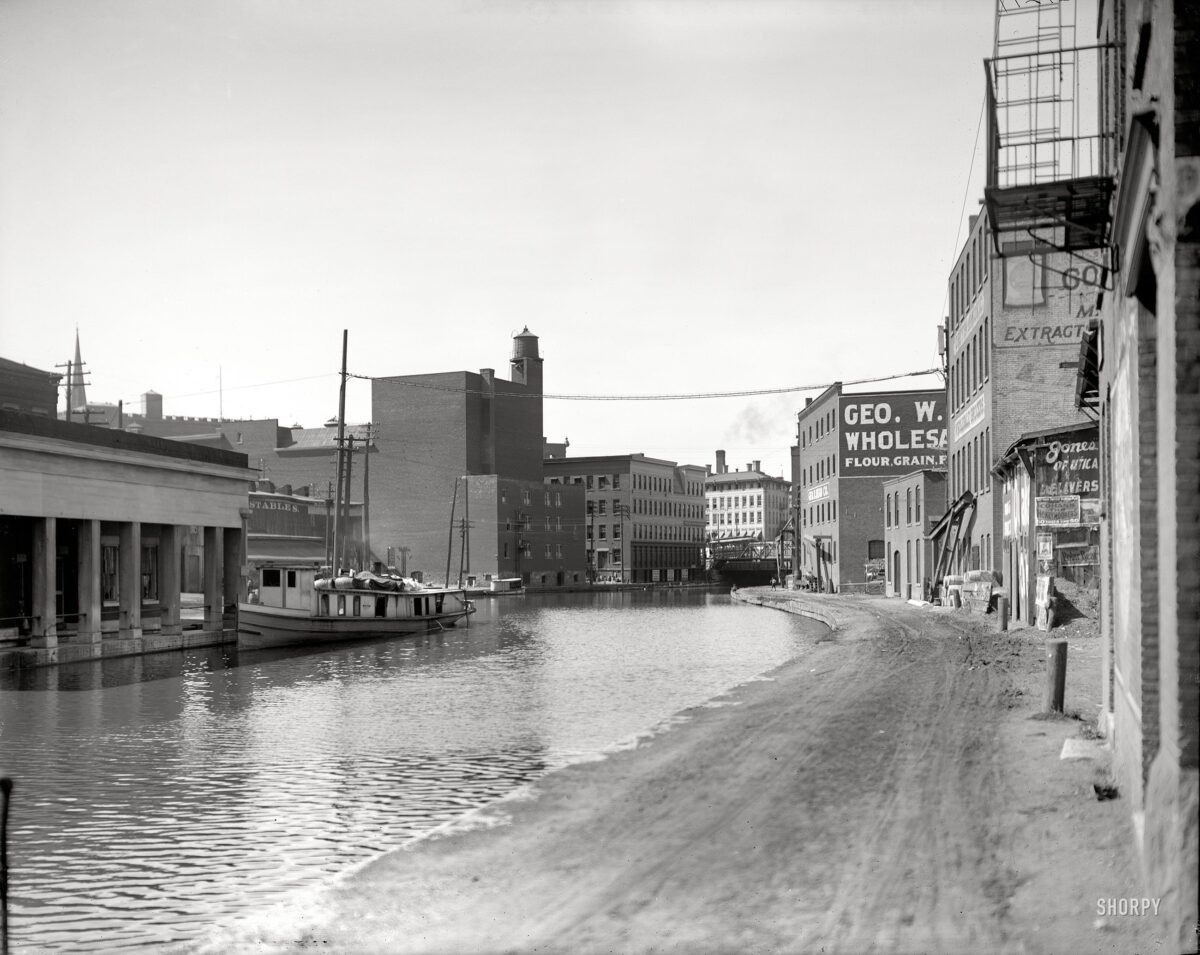
There is a street in Utica, New York called Erie Street, and the name is not accidental. Nothing in Utica is accidental when it comes to the canal. The Erie Canal made this city, shaped its neighborhoods, filled its churches, determined which languages would be spoken on which blocks, and drew to its banks the immigrant families who would spend the next century building the industrial heart of upstate New York. When Joseph Imhoff arrived from Bavaria in the mid-nineteenth century and settled his family at 85 Erie Street, he was not choosing a random address. He was planting himself at the center of the world the canal had created, in the middle of a German Catholic neighborhood whose very existence was the canal’s doing.
This is the story of that canal, that city, and that address.
The Big Ditch and the Men Who Dug It
The idea of connecting the Hudson River to the Great Lakes by a navigable waterway had been discussed since the 1780s, but it took one man’s political tenacity to make it real. DeWitt Clinton, former state legislator, U.S. Senator, mayor of New York City, and eventually governor of New York, believed that a canal through the Mohawk Valley would make New York City the economic capital of the young nation. His opponents ridiculed the project as “Clinton’s Folly” and “Clinton’s Big Ditch,” and President James Madison vetoed federal funding for it, calling it unconstitutional. Thomas Jefferson called it “madness.”
Construction began on July 4, 1817, near Rome, New York, breaking ground not far from the Oneida County communities where the Pryor and Imhoff families would later settle. The first fifteen miles, from Rome to Utica, opened in 1819, and the full 363-mile canal linking Albany on the Hudson River to Buffalo on Lake Erie opened on October 26, 1825. On that day, Governor Clinton boarded a canal boat at Buffalo called the Seneca Chief and began a ceremonial voyage east, arriving in New York Harbor nine days later, where he poured a barrel of Lake Erie water into the Atlantic Ocean in a ceremony he called “the Wedding of the Waters.”
What they had built was, at the time, the longest artificial waterway in North America, and one of the greatest engineering achievements in the world, made more remarkable by the fact that there were no formal engineering schools in the United States when construction began. The men who designed the route, James Geddes and Benjamin Wright, were judges whose primary experience in surveying had been settling boundary disputes. Canvass White was a 27-year-old amateur who persuaded Clinton to let him travel to Britain at his own expense to study canal construction. Nathan Roberts was a mathematics teacher and land speculator. These men and their crews carried the canal up the Niagara escarpment at Lockport, spanned the Genesee River on an aqueduct, and carved its path through solid rock between Little Falls and Schenectady, and all of it worked precisely as planned.
The laborers who dug it worked eight years through wet, hot, and freezing conditions, felling trees and excavating mile after mile mostly with hand tools and animal power. Some were Irish immigrants. Most were U.S.-born men from the farms and towns of upstate New York. They invented equipment to remove stumps and developed hydraulic cement that hardened underwater. They were building something none of them fully understood, and they built it well.
What It Did to the Country
The numbers tell part of the story. Before the Erie Canal, shipping a ton of freight from Buffalo to New York City cost approximately $100 and took about a month. After the canal opened, the same journey cost under $9 and took less than a week. Within a few years, annual freight on the canal eclipsed trade along the Mississippi River, amounting to $200 million, which would be worth more than $8 billion today. By 1853, the Erie Canal carried 62 percent of all U.S. trade. The $7 million cost of construction was fully recouped in toll fees alone within a few years of opening.
The canal transformed New York City from a significant port into the nation’s dominant economic power. The city’s population quadrupled between 1820 and 1850. Financing the canal’s construction allowed the city to eclipse Philadelphia as the country’s most important banking center. The canal provided a direct water route from the Atlantic coast to the Midwest, triggering large-scale commercial and agricultural development and opening the western frontier to settlement at a speed that would not have been possible otherwise. It also carried something harder to measure: ideas. Abolitionism, women’s suffrage, utopian experiments, and religious revivals all found fertile ground along the corridor. The Erie Canal transported more westbound immigrants than any other trans-Appalachian waterway, bringing new languages, customs, and traditions that helped shape the nation.
Abraham Lincoln, as a young politician in Illinois, dreamed of becoming “the DeWitt Clinton of Illinois.”
What It Did to Utica
The transformation of Utica was so dramatic that it reads, in retrospect, almost like something planned, though nothing about it was. The city, known as Old Fort Schuyler until 1798, had been a frontier settlement, a stopping point on the road west, with perhaps 3,000 inhabitants in 1820. It sat at precisely the right geographic moment on the Mohawk Valley corridor, the only natural cut through the Appalachians north of Alabama, and when the canal arrived it became something else entirely.
The first stretch of canal, from Rome to Utica, opened in 1819, and the impact was immediate. Utica’s population grew by 183 percent in the 1820s alone. By 1900, the city’s population had reached 56,000, making it the most rapidly growing city in New York State across that span. The canal did not merely bring commerce. It brought manufacturing. The two arrived together: cheap transportation made production profitable, and the profits financed expansion. A partial list of industries that established themselves in Utica in the canal era tells the story: grist mills and iron foundries in 1823, pottery works in 1826, engine and boiler works in 1832, oilcloth factories in 1832, steam planing mills in 1834, ready-made clothing in 1836, stoves and furnaces in 1842, woolen goods in 1847, cotton cloth in 1848, and knit goods in 1863, the beginning of the textile industry that would define Utica’s economy for the next century.
The Chenango Canal, completed in 1836, connected the Erie Canal at Utica to Binghamton and the anthracite coal fields of northeastern Pennsylvania, and coal became the fuel that kept the new factories running. The canal had created not just a city but an industrial system, and Utica sat at its intersection.
The Immigrants the Canal Brought
The canal did not merely carry goods. It carried people.
The wave of Irish immigrants who came to dig the canal in 1817 were among the first, and they settled along its banks when the digging was done. Then came the immigrants who rode the canal west, and stopped. Then came the immigrants drawn by the factory jobs the canal’s commerce had created, the Germans and the Irish and later the Italians and Poles and Syrians who filled Utica’s neighborhoods through the nineteenth and early twentieth centuries.
The Irish came first in significant numbers. Waves of Irish immigrants came to Utica to help construct the Erie Canal in 1817, and the growing village soon became a stopover of importance. Thousands more Irish and German immigrants, brought by the completed canal, transformed the ethnic and religious composition of Utica and pushed the population from 3,000 in 1820 to 56,000 in 1900.
The Germans came somewhat later. Although Germans were among Utica’s earliest settlers, they did not become numerous and prominent until the 1850s, when a substantial number of “Forty-Eighters,” refugees from the failed liberal revolutions of 1848, and other immigrants primarily from southwestern Germany settled there. By 1910, Germans constituted the largest ethnic group in Utica, supporting several churches, a major German-language newspaper, and many social organizations, among them the Utica Maennerchor, founded in 1865, and the brewing operation that would eventually become the F.X. Matt Brewing Company, dating back to 1888, both of which survive as reminders of the major role Germans played in Utica at an earlier time.
Those German immigrants needed a church. Around the time they began arriving in numbers to work on the Erie and Oswego canals, the German Catholic community of Utica organized itself around what would become St. Joseph’s Church. The present church at 704 Columbia Street was built in 1871, in the German Romanesque style, 180 feet long, with stained glass windows by the Tyrolese Art Glass Company of Innsbruck, Austria. It is now listed on the National Register of Historic Places. It was the spiritual center of the German Catholic world in Utica, and it was the world into which Joseph Imhoff settled when he arrived from Bavaria.
Erie Street and the World It Named
Erie Street in Utica is named for the canal it runs alongside in spirit and in proximity. In the second half of the nineteenth century, the streets nearest the canal’s path through Utica were working-class immigrant neighborhoods, the kind of blocks where you could walk a hundred yards and hear three languages, where the parish church was the organizing institution of daily life, and where the families who had arrived with nothing were building something in the particular way available to them: through labor, through faith, through community, and through the stubborn accumulation of ordinary days.
85 Erie Street was the home of Joseph Imhoff and Louisa Gentz Imhoff and their children. Joseph had been born in Bavaria on September 26, 1849, and had emigrated to Oneida County as part of the sustained German migration that filled Utica’s neighborhoods through the 1850s, 1860s, and 1870s. He married Louisa Gentz, born February 21, 1852, in Saxony, and they built their household on Erie Street in the heart of the German Catholic community centered on St. Joseph’s Church. They were precisely the people the Erie Canal had made possible, immigrants drawn to a city that would not have existed in its industrial form without the waterway that gave their street its name.
Joseph Imhoff lived an extraordinary 87 years, dying on February 18, 1937, at St. Elizabeth’s Hospital in Utica, the same hospital the German Catholic community had founded in a tenement house on Columbia Street in 1866. He had watched the city transform from a canal town into a manufacturing powerhouse and then begin its long, slow transition away from the industries that had built it. Louisa died on December 18, 1929, at 85 Erie Street, at age 77, seven weeks after the stock market crash that ended the era of prosperity she had spent her working life inside. Their son John Frederick Imhoff, born in 1881, grew up on Erie Street and came of age in a Utica that was still very much the city the canal had built.
The Canal’s Long Decline
The Erie Canal was enlarged twice to accommodate wider and deeper boats, and a substantial rerouting was completed in 1918 as the New York State Barge Canal system, which canalized natural waterways like the Mohawk and Seneca Rivers to create a modern commercial route. But the decline had been long in the making. By the end of the 1800s, railroads had begun to outpace the canal as the primary means of transportation. The Utica, Clinton, and Binghamton Railroad arrived in 1866. The New York Central served the city with multiple lines. The canal that had made Utica now shared its function with a rail network that could operate year-round, regardless of ice.
Commercial and shipping traffic declined abruptly after the completion of the St. Lawrence Seaway in 1959, which gave ocean-going vessels direct access to the Great Lakes, bypassing the canal entirely. The 1954 opening of the New York State Thruway, which bypassed the city of Utica, compounded the economic damage. Mill after mill shut down in the postwar decades. General Electric and Lockheed Martin closed their Utica plants in the 1980s and 1990s. The city that the canal had built in a generation contracted across the latter half of the twentieth century in the way that Rust Belt cities contract, gradually and then all at once.
What Remains
The canal itself still exists, though tourism is now its main source of traffic. The towpath that mules once walked is a 365-mile bike path. The locks that lifted and lowered boats across the elevation changes of upstate New York still operate, maintained as a National Heritage Corridor administered by the National Park Service. The Erie Canal was designated a National Heritage Corridor by the U.S. Congress in 2000, a recognition that what it represented was worth preserving even after its commercial function had passed.
The Utica Canal Terminal Harbor is still connected to the Erie Canal and the Mohawk River. The streets of the old canal neighborhoods still carry the names they were given in the canal era: Erie Street among them.
And 85 Erie Street still exists, though the world Joseph and Louisa Imhoff inhabited there is long gone. The German Catholic neighborhood around St. Joseph’s Church has changed beyond what either of them would recognize. The church itself still stands on Columbia Street, in the German Romanesque style, the Tyrolese windows still intact, listed on the National Register of Historic Places. The hospital that the German Catholic Franciscan sisters founded in 1866, St. Elizabeth’s, where Joseph Imhoff died in 1937, still operates as St. Elizabeth’s Medical Center.
Erie Street still runs through Utica. The canal is still there, reduced to a recreational waterway but physically present, the water still moving through the locks that the amateur engineers and the hand-tool laborers of 1817 first designed. The address 85 Erie Street carries in its name the full weight of what the canal did: it named a street, and the street named a neighborhood, and the neighborhood drew a German immigrant family from Bavaria, and that family built its American life at that address across three generations, and the imhoff.us archive preserves their names today.
DeWitt Clinton poured Lake Erie water into the Atlantic Ocean in November 1825 and called it “the Wedding of the Waters.” What he had really done was create the conditions under which a Bavarian farmer named Caspar Imhoff would send his son Joseph across an ocean to a city that would not have been there without the canal, to a street that bore the canal’s name, to build a life that the canal had made possible.
The canal did not merely connect Albany to Buffalo. It connected Frammersbach, Bavaria to 85 Erie Street, Utica, New York.
This article was compiled from records in the imhoff.us genealogical database, the Clinton Historical Society archives, the Landmarks Society of Greater Utica, and historical research into the Erie Canal and the city of Utica. If you have photographs, documents, or personal memories related to the Imhoff family of Utica or to any of the families documented in this archive, contributions are welcomed through the Contact page.