
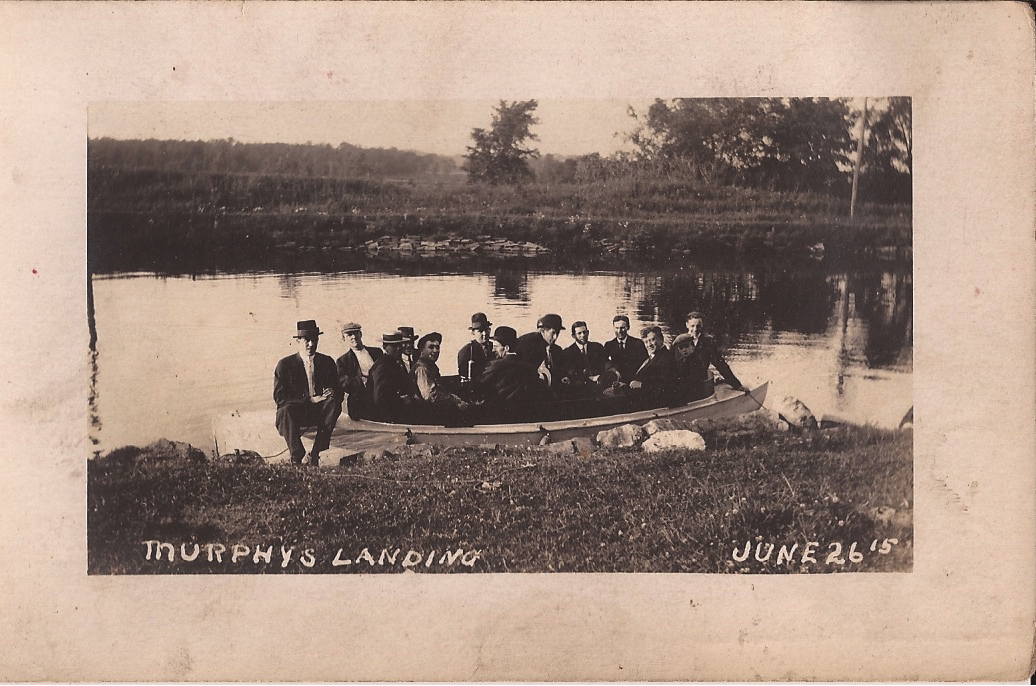
John Frederick Imhoff was born on December 5, 1881, in Utica, New York, the son of Joseph Imhoff and Louisa Gentz. He was baptized six days later at St. Joseph’s Church on Utica’s south side, and grew up at 85 Erie Street, within earshot of the very canal that would one day carry him on his afternoon excursions. He completed school through the seventh grade, as was common for working-class boys of his generation, and built a life through hard physical labor. By 1930, census records show him working as a laborer on steam engines, earning $3,000 a year, a trade that gave him a practical familiarity with boilers, pressure, and the mechanics of vapor-driven machinery. In July 1909, he married Rose Landry of Sherbrooke, Canada, at Saint Paul’s Church in Whitesboro, with George Gregoire serving as best man. Together they would raise four sons: Peter, Walter, Joseph, and John Jr.
In 1915, at thirty-three years old, John was living at 103 1/3 Erie Street when he made a purchase that left a small mark in the local newspaper record. Hardcastle Brothers had sold their naphtha launch Alice to John Imhoff of that address, and the transaction was duly noted in print. This was not John’s first brush with the used-boat market, the family archive records a sale or transaction as early as July 2, 1912, noted in the Utica Herald Dispatch, suggesting an ongoing interest in recreational boating on the canal. But the Alice is the boat we have a face to put to: a photograph, dated June 26, 1915, and preserved in a box passed down from Richard J. Imhoff, shows the launch at a location identified as Murphy’s Landing. John sits to the left.
The naphtha launch, sometimes also called a vapor launch, was a distinctly American invention, born not from engineering preference but legal necessity. U.S. law, prompted by a history of boiler explosions, required that all steam-powered vessels carry a licensed engineer at all times. While this posed no obstacle to a commercial craft with a professional crew, it effectively barred ordinary citizens from operating small steam launches for personal use, since qualifying as a licensed engineer required a two-year apprenticeship beforehand. The naphtha engine was the workaround. The technology originated with Swedish-American inventor Frank W. Ofeldt, who patented the naphtha engine in 1883 as an improvement over steam power for small boats, using a heated retort to evaporate naphtha into vapor that expanded to move the engine’s cylinders, with condensers recycling the fluid for efficiency. By 1903, the Gas Engine & Power Company had manufactured over 3,000 such engines, often installed in copper-and-brass-constructed boats capable of 2 to 6 horsepower and speeds up to 7 miles per hour.
The typical naphtha launch ran about 24 feet in length and was designed as a pleasure craft for fine-weather excursions. The fuel tank was positioned in the bow of the boat, well away from the engine and the risk of fire, pressurized by the returning naphtha to eliminate the need for a fuel pump. Starting the engine required a hand air pump to pressurize the fuel tank and a small flame to pre-heat the burner coil, a ritual that demanded a certain mechanical confidence from the operator. For a man who spent his working days around steam engines, John Imhoff would have found none of it foreign.
Naphtha launches appeared in the finest circles, in the best yacht clubs, and under the ownership of some celebrated names. By 1915, however, the technology was already giving way to the gasoline engine, and a secondhand naphtha launch like the Alice represented the previous generation of recreational boating. That John acquired her from a local dealer rather than new speaks to the practical economics of a working man’s leisure. He was not a Vanderbilt. He was a laborer on Erie Street who wanted to spend a Sunday afternoon on the water with his family.
Murphy’s Landing, the location identified in the photograph, appears in the Annual Report of the Superintendent of Public Works of the State of New York from 1903, which places it on the Erie Canal between Rome and Utica, a stretch of water John would have known as a neighbor his entire life. A copy of the photograph has been sent to the Oneida County Historical Society, which has agreed to research the precise location. Whatever they find, the image itself is already a document. A man who lost his right eye to an unrecorded cause, who raised four sons, who worked steam engines by trade, sits to the left in a boat named Alice on a summer day in June, on a canal that once ran past his father’s door.